The Slack Thread That Ends as a Pull Request When a Cloud Agent Handles the Task
Four infrastructure layers make Slack-to-PR agent workflows reliable.
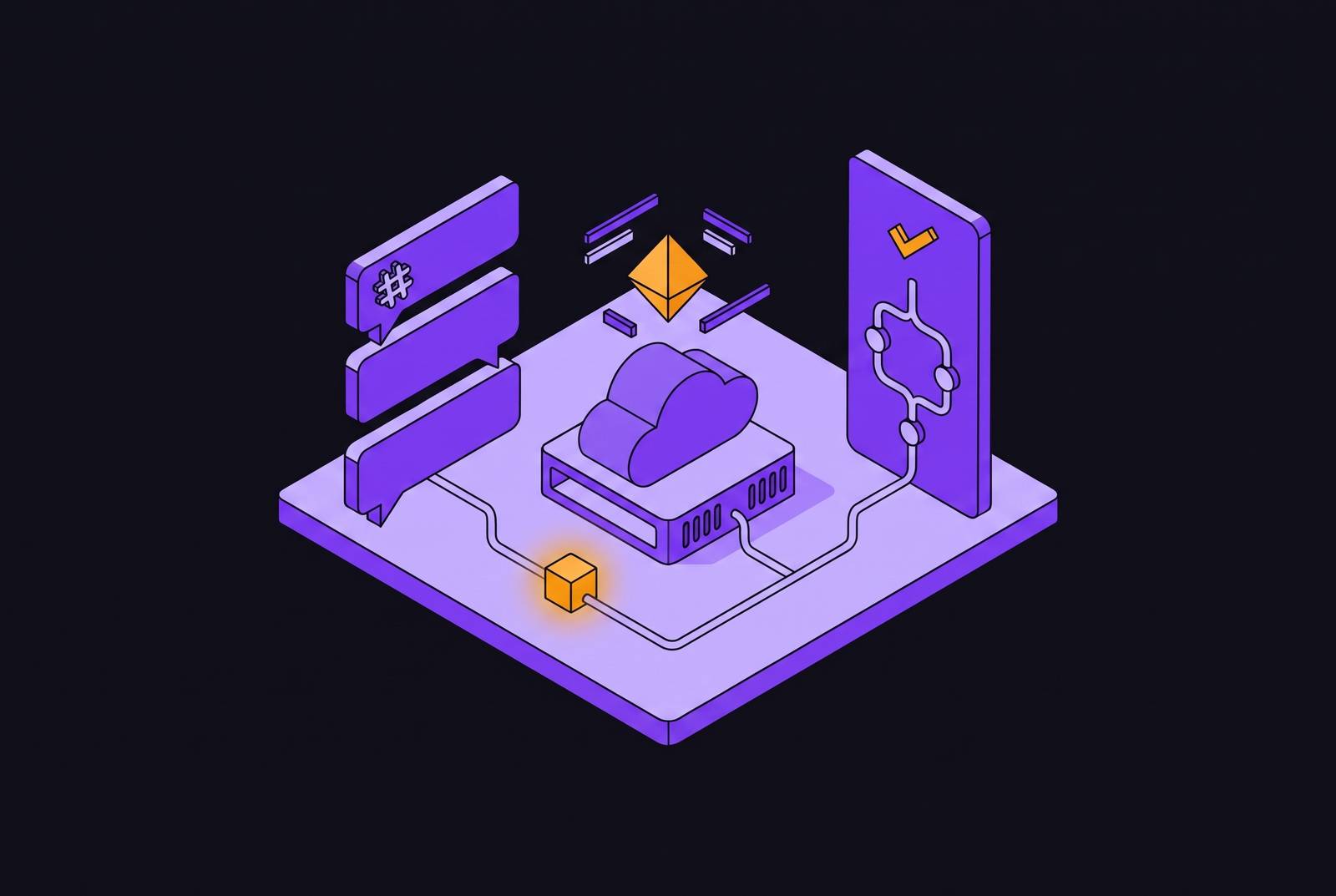
Running Claude Code in the cloud requires an isolated execution environment, permissioned repository access, and an agent session that can continue without a developer’s local machine. A Slack-triggered workflow adds a chat-native dispatch layer that connects the request to that session. The route from thread to pull request becomes reliable when teams configure these four layers together, rather than treating the Slack integration as the whole system.
Why the Slack-to-PR workflow is harder to replicate than it looks
A teammate mentions a bug in Slack, and an hour later someone posts a pull request link. What the team sees looks easy to repeat. Behind it, however, an agent session had to start, select an isolated environment, authenticate against the repository, execute without supervision, and return its result. A gap anywhere breaks the handoff. Installing the chat integration addresses only the entry point.
The deeper change is who delegates and where. An IDE assistant gets work from a developer in private, while a Slack-triggered agent gets work where the team talks through requirements and trade-offs. That shared entry point turns conversation into an input to an execution system. Context management, permissions, sandboxes, audit records, and cost controls therefore become engineering concerns to address while making the model work.
How the chat-native trigger actually starts an agent session
An @mention must resolve to more than a chatbot response. It has to identify an agent harness, select an execution environment, pick up repository context, and confirm the requester’s permissions before code changes begin. The mention is a dispatch signal. Where the mention goes decides which agent and environment get the work, so teams gain more from being able to change routes than from sticking with one vendor’s Slack app.
OpenAI’s workspace agents, launched April 22, 2026, make this mechanism concrete. An @Codex mention in a channel creates a cloud task, selects a matched environment from the user’s configured repositories, and posts results back to the thread. Repository selection is not always explicit. The integration scans accessible environments and matches repository names in the prompt or thread, falling back to the most recently used environment when the request is ambiguous. Teams with multiple repositories therefore need an accurate repository map rather than an assumption that conversational context identifies the codebase.
Authorization must remain separate from that matching process. Channel membership does not grant codebase access. The practical rule is that a person deliberately sends work to the agent, through a mention or an emoji, and the agent never merges autonomously. That preserves a human decision at dispatch without requiring a human to supervise every execution step.
What Slack Code adds: shared visibility and the dedicated code channel pattern
Slack Code is the collaboration layer. A dedicated code channel exposes the plan, code diffs, live HTML previews, and conversation context around the task. This lets the team see the scope before coding starts and gives them a shared place to review proposed changes. People who are not engineers can check whether a preview meets the requirement. Teams can steer and watch the work together, though this does not in itself make code generation faster.
Slack’s launch announcement named Anthropic’s Claude, Cognition’s Devin, GitHub Copilot, and Vercel integrations, with OpenAI’s ChatGPT listed as coming soon. Those integrations provide the agents that do the work behind the shared channel. The distinction is operationally important. A common channel does not make their execution environments, model choices, or permission systems identical, so visibility cannot substitute for understanding the agent actually running the task.
Branch protections, testing, code ownership, and merge approval still govern the pull request after the channel’s work is done. The archived channel becomes a searchable project record, preserving the discussion needed to understand why the change happened. That record supports later attribution and investigation. It does not, by itself, establish that the code is safe or correct.
How do you run Claude Code in the cloud with the isolation the task needs?
The sandbox makes unattended execution practical and safer. An agent that installs packages, starts services, drives a browser, and verifies changes needs an environment that does not interfere with anyone’s local machine. Execution must survive the developer stepping away. To run Claude Code in the cloud for this work, the environment must support the task’s tooling and verification needs, rather than simply provide somewhere to launch the agent process.
Isolation models differ, including within the same product family. Claude Code offers opt-in sandboxing through Bubblewrap on Linux and Seatbelt on macOS for its local execution model. GitHub Copilot’s coding agent instead uses a cloud-native, ephemeral environment powered by a workflow automation service. OpenAI’s developer documentation distinguishes Codex CLI’s operating-system sandbox policies from Codex cloud’s isolated, OpenAI-managed containers. These are not interchangeable deployment choices. Managed cloud execution can remove infrastructure work, but it does not remove the need to understand the isolation boundary.
The harder requirement is verifying the whole application. A sandbox that isolates an agent does not necessarily provide a full-stack ephemeral environment on the team’s own cloud in which it can deploy and verify its work. The relevant questions include repository restrictions, protection for sensitive credential files, outbound-domain limits, tool-call approval, and rollback. Where the task requires packages, services, and output verification, the brief’s operational recommendation is a full isolated VM or container preloaded with the team’s tooling.
Permissioned repo access: how authorization flows from chat to codebase
The authorization chain is the workflow’s easiest boundary to misunderstand. The ability to ask for a change must not become the ability to write to any repository the agent can reach. Even when a patch is correct and passes tests, it still needs the team’s approval and must clearly show which agent identity produced it.
For teams configuring this boundary, repository scope and merge approval are concrete controls. Repository administrators can require additional approval before a pull request attributed to the Copilot app identity can merge. Agent access should be narrow, including the scopes granted through hosted MCP servers. Linear’s hosted MCP integration adds another permission surface by allowing an agent to read and write Linear information. Those permissions need deliberate configuration rather than inheritance from the breadth of the conversation.
The objection that the team is trusted misses the boundary. The exposure is what the agent can reach. Teams should keep secrets and unrelated customer data out of threads the agent can see, and decide when a discussion has enough authority to let the agent start implementation work. Financial permissions also deserve explicit configuration. Teams can control Copilot usage through the entitlements and cloud-agent AI-credit budgets they already have, while cloud sandbox compute has its own bill under a product-level or individual billing-item-level budget.
Async execution: what it means that the agent keeps working while the team is in a meeting
Async execution changes which work is economical to delegate. An agent can handle a bounded task while the team is unavailable instead of waiting for someone to find an uninterrupted block of time. Suitable work is testable and reviewable. Adding tests, upgrading dependencies, fixing lint errors, mechanical refactors, synchronizing documentation, and handling small bugs fit because execution time, rather than unresolved product judgment, is often the constraint.
OpenAI’s workspace agents extend this model beyond a single background run. They can schedule work for later, pick up multi-day tasks where they left off, and keep information across sessions, so recurring maintenance can run without external cron infrastructure. Unattended work makes earlier configuration more consequential. The environment and permissions must still fit the task when nobody is watching the agent choose what to do next.
Doctolib added Claude Code to its CI pipeline through headless mode to open pull requests for routine maintenance automatically and keep technical documentation up to date. That work included reducing the time to replace old testing infrastructure from weeks to hours.
More generated pull requests do not automatically mean more merged work, and writing-side gains can be absorbed by a review queue that does not scale. The full pipeline goes from trigger to execution, review, and merge. Teams should define review SLAs for agent-authored pull requests separately from human-authored ones, so delegated work has an explicit path beyond generation.
Choosing which agent harness runs the task, and why staying flexible matters
Harness selection is a routing decision made per task. Agents differ in model access, isolation, and autonomy, so the choice for a batch refactor need not suit a long, context-heavy feature. Model restrictions are particularly concrete. Claude Code runs only Anthropic models, while Codex runs only OpenAI models, so each harness depends on how well its provider’s models work and what they can do.
The late-2026 options come with different trade-offs, and no one choice wins across the board. Codex combines an open-source CLI with stricter default sandboxing and is strongest for batch refactors with light supervision. GPT-5.5 comes first on Terminal-Bench in the comparison provided. Cursor includes its own models, including Composer 2.5 and Grok 4.7/4.6/4.5, in its subscription. Its Premium and higher plans charge API list prices for third-party models, while Free and Plus cannot use them.
OpenCode takes a different approach to model selection. It has no model of its own and connects to a configured provider or local server, offering flexibility for private deployments and teams with strong model preferences. Benchmark leaders changed multiple times during 2026. It helps teams to be able to switch harnesses without rebuilding the trigger, environment, or attribution layer.
What full attribution looks like when an agent runs in the background
Operational attribution links each pull request to the agent, harness, model, and credential that produced it. Teams need those links to tell what shipped from what only ran and to compare what they spent with the useful work they got. The workflow becomes reproducible when teams understand its components well enough to measure their contribution and diagnose failures.
Slack Code’s archived channel supplies the reasoning around the change. Its plan, diffs, conversation context, and scope decisions help a future maintainer reconstruct why the work took its final form. Cost needs a corresponding task-level view. Linear Agent bills model tokens at provider-published rates without markup, plus $0.25 per 20-minute block of sandbox runtime, from a prepaid workspace-level pool of AI credits. That separates model consumption from the time spent running the environment.
Salesforce reported in April 2026 that developers completed far more work items and merged far more pull requests per developer than in the year before. Its ML-based Effective Output score also showed dramatic year-over-year growth without doubling headcount, as teams reorganized around AI agents. For an engineering leader, the useful question is whether the record reveals what worked, what it cost, and what it shipped.
What reliable replication of the Slack-to-PR workflow actually requires
After a team’s first successful run, it should set out the dispatch contract before taking on more work. That means deciding which human-selected Slack signals warrant execution, which harness receives each task, and what happens when environment matching selects the wrong repository. Ambiguity needs an explicit operational response. Otherwise, a convenient fallback can become an unexplained change in where the work runs.
Environment configuration and authorization should then match the delegated task. The agent needs the tooling and isolation required to execute and verify its output, with documented write access to specific repositories. Pull requests attributed to an agent should still need the additional approval gate. These decisions define what unattended execution is allowed to accomplish, while a separate review SLA defines how its output reaches a human decision.
Scaling should depend on that complete path working repeatably. A team should be able to change harnesses without losing its dispatch rules or attribution, and increased generation should not outrun review capacity. Installing a Slack app is not that operating model. Before sending more work to agents, engineering leaders must decide whether the workflow shows enough about cost, shipped output, and review capacity to support that choice.