Access Control for Slack-Initiated Agent Runs
Slack-triggered agents need explicit policies for who can trigger, redirect.
When a coding agent runs only inside a developer's terminal, access control needs no design: the person at the keyboard is the only one who can trigger, stop, or ship anything. Slack Code changes that premise. The communication layer becomes the control plane for agent work, which means access control must now be designed as an explicit, multi-layer model rather than inherited from the private, single-actor world of local execution. This is not a marginal change in who uses coding tools. It is a change in who can initiate consequential engineering actions and who is responsible for their outcomes.
Consider the non-technical teammate scenario: a product manager spots a bug report, tags an agent, the agent proposes a fix, an engineer reviews the diff inside the same channel, and the change merges. No terminal, no branch, no pull request opened by a human developer. Nothing shipped without a person's action, but the person who triggered the work and the person who approved it were never the same, and neither held a keyboard. When coding agents run through platforms like Replicas, access control shifts from implicit trust in a single developer at a terminal to explicit policy over any team member in a channel who can initiate a run that produces production-ready code. The old model's single gate no longer holds, so engineering teams need a replacement built for the granularity the new flow demands.
What "Access Control" Actually Means When an Agent Can Be Triggered, Redirected, and Merged From Slack
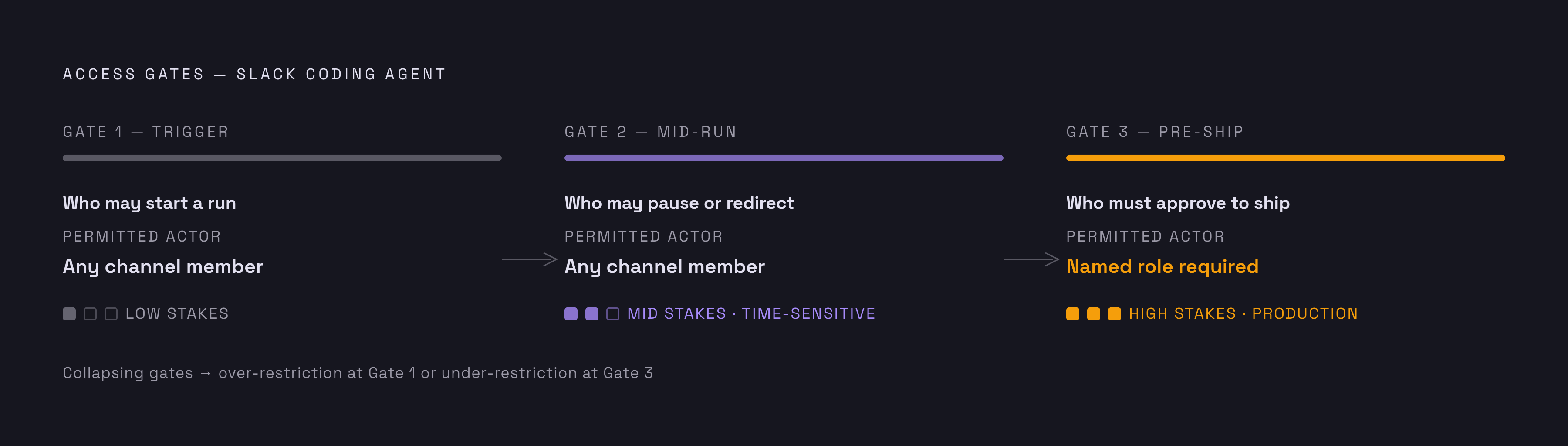
Access control for agent runs is not one permission. It is three decisions made at three distinct moments, and each has different stakes and different actors. The first moment is triggering: who may tag an agent and start a task that will consume compute, access a repository, and potentially open a pull request. The second is mid-run intervention: who may pause, redirect, or stop an agent that is already executing. The third is pre-ship approval: who must sign off before an agent's changes reach production.
These moments differ in more than timing. A trigger is broad but shallow, the kind of action a product manager might legitimately take. A redirect is time-sensitive and benefits from the person closest to the emerging context. An approval is high-stakes and requires genuine technical authority over the code in question. Treating all three as one decision leads to either over-restriction that blocks legitimate use or under-restriction that lets the wrong people approve production changes. So a coherent model treats each layer on its own terms, with its own actors and its own failure modes.
What Slack Code Provides Out of the Box, and Where the Gaps Appear
Slack Code inherits Slack's existing permissions and admin controls, so IT has nothing new to configure for basic governance. Channel membership and agent-seat licensing gate who can start a run, with Slack's existing workspace and channel admin controls governing who is in which channel. Anyone in a code channel can pause, redirect, or stop an agent mid-task, and the Agents & tools tab offers the same kill switch across all sessions in the workspace. This broadness is deliberate: it reflects the premise that shared visibility lets the team catch wrong assumptions before they compound. Before production pushes, the agent packages the change and waits for a human to approve it inside the channel, a gate enforced at the agent's action level rather than the Slack permission level. The channel archives itself upon task completion and preserves a searchable audit log of who asked for what, what the agent changed, and who approved it.
The gaps are design questions, not product failures. Channel membership is a coarse trigger gate: it does not encode seniority, domain ownership, or scope constraints, so a junior intern and a senior engineer who both hold channel membership can trigger runs with equal authority. Mid-run intervention has the same flatness: any channel member can redirect an agent, with no role-based distinction at that layer. The approval gate requires that a human approve, but the platform does not at launch enforce that the approver holds a specific role or repository permission. A thumbs-up in a busy channel is not a code review, and the visibility of diffs makes approval socially faster but not necessarily more rigorous. The Agents tab's workspace-wide scope also raises a question: whether any workspace member can stop any agent run, not just those in the relevant channel. The platform provides the skeleton, but engineering teams have to layer conventions and, where possible, tooling on top.
Designing the Trigger Layer: Who May Start a Run, and Against Which Scope
The trigger layer is where scope control lives. The question is not merely who can start a run but which repositories, branches, and services a given actor is permitted to target. Because code channels are provisioned per-task and scoped to the conversation where the agent is tagged, channel membership is the practical enforcement point. A team that organizes channels by service boundary, a payments channel, a frontend channel, a data-pipeline channel, can use channel membership to enforce that only people with legitimate context in a domain can trigger agent runs against it. This is a convention rather than a platform-enforced policy, but it fits naturally with how Slack's permission model already works.
Repository and branch scope can be tightened further at the harness level. GitHub Copilot's integration assigns agents to GitHub Issues and opens changes as draft pull requests against the relevant repository, which ties the issue-assignment step to GitHub's own repository permissions as an additional gate. Non-technical teammates can trigger agents, review output, and guide development, a deliberate design goal of Slack Code, but engineering teams need to decide explicitly which channels those teammates can trigger runs in rather than defaulting to workspace-wide access.
Automated triggers complicate the picture. Replicas supports webhook, schedule, and API-triggered runs, so agent work can begin with no human in the channel at all. A trigger policy that relies solely on channel membership therefore has a gap: an automated invocation can bypass the channel-level gate entirely. The trigger policy must extend to automated sources, with the same repository scope constraints applied to scheduled or webhook-driven runs as to human-triggered ones.
Designing the Mid-Run Intervention Layer: Who Redirects a Running Agent, and When
When you want shared visibility, broad mid-run intervention rights are the right default. A teammate can catch a bug before it ships, flag a constraint before the agent runs with it, or pause and redirect mid-task. Early intervention is cheaper than post-hoc review because the agent has not yet built on a wrong assumption. The audit log captures every plan, diff, and team comment, which means a redirect is not invisible governance. It is recorded governance.
The problem is coordination. If three people with different views on the implementation send conflicting redirects to the same agent, the agent's execution becomes incoherent. The permission model did not fail. The team's process did. The channel's conversation tab is the natural place to reach consensus on a redirect before issuing it, rather than having individuals act directly and independently. One practical norm is to designate the person who triggered a run as its owner, the person responsible for steering it and for incorporating the redirects that others propose in the channel. The triggering person opened the conversation, which makes them the natural coordinator even though the platform does not assign the role.
The Agents & tools tab deserves explicit treatment. It flags blocked threads and offers the same kill switch across all sessions, which is the right tool for an engineering lead or on-call engineer who needs to stop a run that has gone wrong. But its workspace-wide scope means teams should decide who holds that role, rather than leaving it implicitly open to everyone.
Designing the Approval Layer: Making Pre-Ship Sign-Off Meaningful Rather Than Social
The approval layer is the highest-stakes gate, the last point at which a human decision stands between agent-generated code and production. Slack Code routes high-stakes changes to a person for a fast approval right in the channel, so teams get the speed of automation without giving up the confidence of a review. But the platform enforces that an approval happens. It does not enforce that the approver has actually reviewed the diff, holds repository write access, or has the domain expertise to evaluate the change. A thumbs-up in a busy channel is not a code review.
Visibility makes this problem worse. Code diffs and live previews in a shared channel make approval socially visible, and everyone can see whether someone has approved, which creates implicit pressure to approve rather than to scrutinize. A busy channel with multiple simultaneous agent runs amplifies the effect: approval becomes a flow state rather than a deliberate act. If you want sign-off to be meaningful, you have to design the approval step explicitly. That means naming in advance which role, a senior engineer, a tech lead, a service owner, holds approval authority for a given channel or domain, rather than accepting approval from whoever responds first. It means establishing the norm that approval requires having reviewed the diff tab, not just the conversation summary.
Repository-layer enforcement is the most robust mechanism. Replicas returns agent output as a pull request through the team's standard GitHub or GitLab review process, so you can enforce the approval gate with required reviewers and branch protection rules instead of leaving it to a channel-level convention. This gives teams a mechanism that does not depend on social norms holding under pressure. For regulated teams, the channel's audit log is the artifact their compliance and security teams need. The approval step must be legible in that log, attributable to a named person and a specific change, not just visible in conversation history.
The Sandboxed Environment as a Second Enforcement Point
Channel-level access control governs who can trigger, redirect, and approve. The agent's execution environment governs what the agent can actually reach, and the two must be aligned rather than treated as independent concerns. Replicas runs each agent in an isolated Linux VM with the repository, tools, dependencies, and services it needs. The agent can install packages, run databases, and verify its own changes, but it operates within a boundary the team controls independently of whatever happens in the Slack channel. An isolated VM means that even if a trigger or mid-run redirect is mistaken, the blast radius is bounded: the agent cannot reach systems outside its provisioned environment.
Credential scope works the same way. Replicas lets teams select which GitHub or GitLab repositories agents are enabled against, and attributes every minute of a run to a source, person, harness, model, credential, and the skills and MCP servers the agent reached for. Execution-layer access is therefore explicit and auditable rather than implicit. This is the complement to the channel-as-domain-boundary convention: if a channel covers the payments service, the agent's VM should be provisioned with credentials scoped to the payments repository, not the entire monorepo. Harness-level safety controls provide a further layer. Claude Code's hook system, with up to 33 hook events, allows teams to intercept and validate agent actions before they execute, independent of what the Slack channel permits. GitHub Copilot's integration enforces that changes open as draft pull requests, which respects the repository's existing branch protection and required reviewer settings.
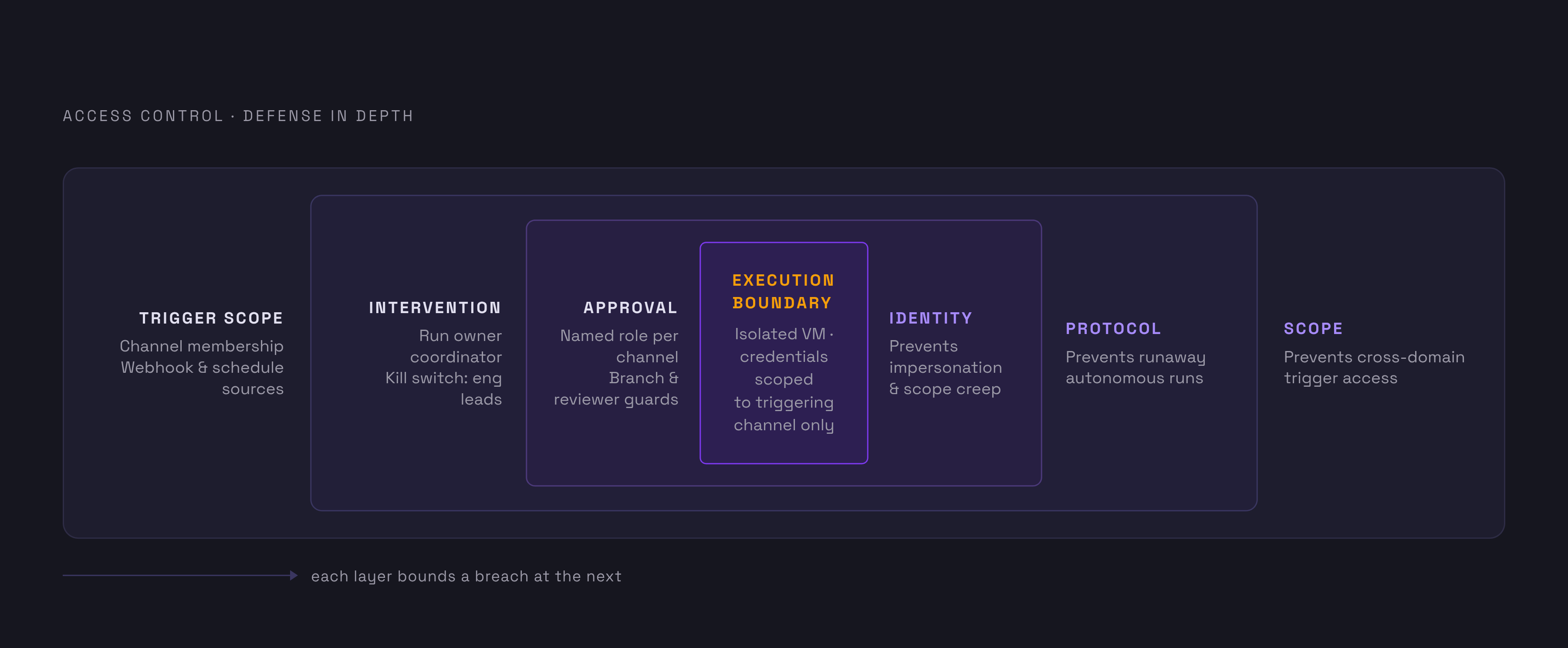
Sandboxes solve code execution isolation. They do not solve verification that the agent's output is correct or safe. That remains the job of the approval layer and human review. When you combine the isolated execution environment, channel-level governance, and repository-layer approval, you get defense in depth, and each layer limits what a failure at another layer can cause.
A Working Model: Trigger Scope, Intervention Protocol, Approval Identity, Execution Boundary
A working access control model for Slack-triggered agent runs has four components. Trigger scope governs who may start a run and against which repositories and services. Intervention protocol governs who may redirect or stop a running agent, and how conflicts get resolved. Approval identity governs who must sign off before production, and you have to enforce that sign-off. Execution boundary governs what the agent's environment can actually reach. Each component matches the stakes of its layer.
For trigger scope, organize code channels by service or domain boundary, and make channel membership the primary gate. Only people with legitimate context in a domain should be in the channel where agents can be tagged against its services. You should extend the same policy explicitly to automated sources, because webhook- and schedule-triggered runs need the same repository scope constraints as human-triggered runs. For intervention, designate a run owner, the person who triggered the run, as the coordinator of mid-run redirects. Others propose redirects in the conversation tab. The owner decides and issues them. Reserve the Agents tab kill switch for engineering leads and on-call engineers, as an explicit team norm rather than an open default.
For approval identity, specify in advance which role holds approval authority for each channel or domain, and do not accept approval from whoever responds first. At the repository layer, use branch protection rules and required reviewers to reinforce the gate. This makes the gate hold even when social dynamics in a busy channel create pressure to approve quickly. For regulated teams, ensure the approval step is attributable in the channel's audit log by name and change. For execution boundary, provision each agent's VM with credentials scoped to the repositories and services the triggering channel covers, matching execution scope to channel scope explicitly rather than by default. The per-run analytics that attribute every minute to a source, person, harness, model, credential, and the skills and MCP servers the agent reached for give teams the observability to verify that boundaries are holding and to detect runs that exceed their intended scope.
The model scales at both ends. A small team may implement most of it as convention. A large organization with regulated services will enforce it at the platform layer. The four-component structure applies either way, because the underlying problem is the same: when Slack becomes the control plane for agent work, access control is no longer a property of the terminal. It is a property of the channel, the repository, and the execution environment, designed deliberately across every layer where a decision gets made.