Routing Agent Tasks From Slack to Linear Automatically
Turns Slack conversations into tracked work and hands it straight to coding agents.
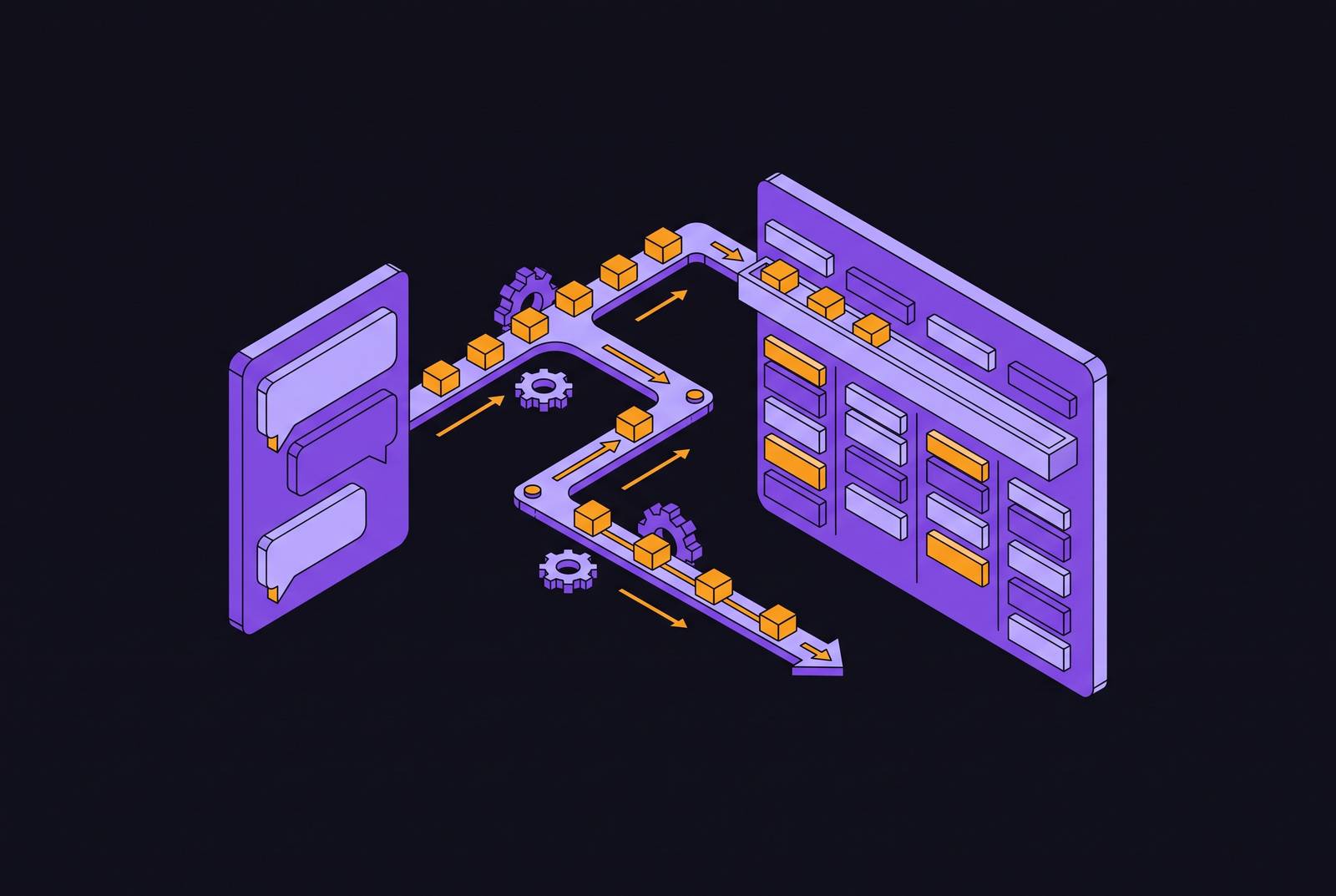
The bottleneck in modern software delivery sits before a single line of code gets written. It lives in the gap between a conversation and a tracked issue. A bug surfaces in a Slack thread. Someone writes "we should fix this." The thread scrolls past, the context dissolves, and the work never makes it into Linear. This failure pattern repeats across nearly every engineering team that relies on Slack for real-time discussion and a separate tracker for the system of record, and it costs teams more than missed tickets: it costs them the attention of engineers who have to stop writing code to manually copy text, switch tabs, and populate form fields just to make sure an idea doesn't disappear. That manual transcription step breaks concentration and invites error, so the coordination overhead it creates competes directly with the technical work it is meant to support. The pipeline this article traces exists to close that gap: a Slack message triggers issue creation in Linear, Linear routes that issue to a coding agent, and the agent returns a pull request, with no manual handoff required at any point in the sequence.
Turning a Slack Message into a Structured Issue
The first hand-off in the pipeline happens the moment someone mentions @Linear inside a Slack conversation. In a public channel, any member can invoke the agent this way, and once mentioned, the agent joins the channel and can listen to the discussion that's already underway, drawing context from the surrounding messages as well as the single line that summoned it. Group direct messages work differently: Linear's agent has to be invited at the moment the group DM is created, because Slack's permission model doesn't allow it to be added to a conversation that already exists. A team that forgets to add the agent at DM creation has no later path to retrofit it.
Once invoked, the agent doesn't publish an issue right away. It drafts a preview, complete with title, description, assignee, and labels, and presents that draft back in Slack for review. A user can adjust any field through a dropdown or by simply describing the change in plain language, and only after that confirmation does the issue move into the tracker. This human-in-the-loop step is the checkpoint that keeps a misread thread or an ambiguous request from turning into a malformed ticket that lands, unexamined, on an engineer's desk. Linear Agent launched in March 2026, and since then it has picked up better recognition of informal delegation language, so a message as casual as "@Linear work on this" or "@Linear go" is read correctly.
Slack is the channel this article follows closely, but it isn't the only door into the same system. As of April 2026, Linear Asks lets custom web forms, email, Intercom, Zendesk, and even Gong call transcripts feed into the same triage inbox that Slack messages land in. Every submission, regardless of where it originated, arrives in that shared inbox, where a team member can pick it up directly or let Triage Intelligence route it automatically. The pattern generalizes well beyond chat, but the mechanics an engineer needs to understand day to day are the ones that run through Slack.
Writing custom instructions so the agent routes and scopes issues correctly
Invoking the agent correctly solves only the first problem. But once dozens of engineers across multiple teams are mentioning the agent in dozens of different threads, you have to make sure it behaves predictably. Left on its own, an agent with no guidance acts as a passive transcription tool: it applies generic labels, assigns issues to the wrong team, and writes titles that ignore whatever naming conventions a team has built up over time. The fix is a set of custom instructions, written in natural language inside the Slack integration settings panel, and they function less like configuration and more like a triage filter sitting in front of every engineer's queue.
A well-built instruction set typically covers four things. First, a required description structure, so every issue arrives with the same shape, for instance three sections labeled User Impact, Steps to Reproduce, and Technical Context. Second, routing rules tied to the actual language in the thread: a mention of frontend styling or CSS routes to Design Engineering with a "ui" label, while backend errors or slow queries route to Core Infrastructure with a "performance" label. Third, escalation thresholds that keep priority levels honest, such as a rule that nothing gets marked higher than Medium unless the thread contains words like "outage," "crash," or "security exploit." Fourth, a gatekeeping rule that stops the agent from creating an issue at all when something critical, like reproduction steps, is missing, and instead has it ask the user for the missing piece.
One architectural detail deserves particular attention. Teams that give the agent a single, unified tool set covering both issue creation and data lookup tend to see the model make the wrong call: asked to simply create an issue, it starts trying to gather arbitrary supporting data to fill in fields nobody asked it to populate. Splitting intent classification, create versus query, at the front of the system with a small, fast model and routing each request to a specialized subsystem with its own focused prompt produces both higher accuracy and faster responses. It is a small design choice, but it decides whether the agent stays predictable at scale or starts improvising.
Delegating the issue to a coding agent directly from Slack
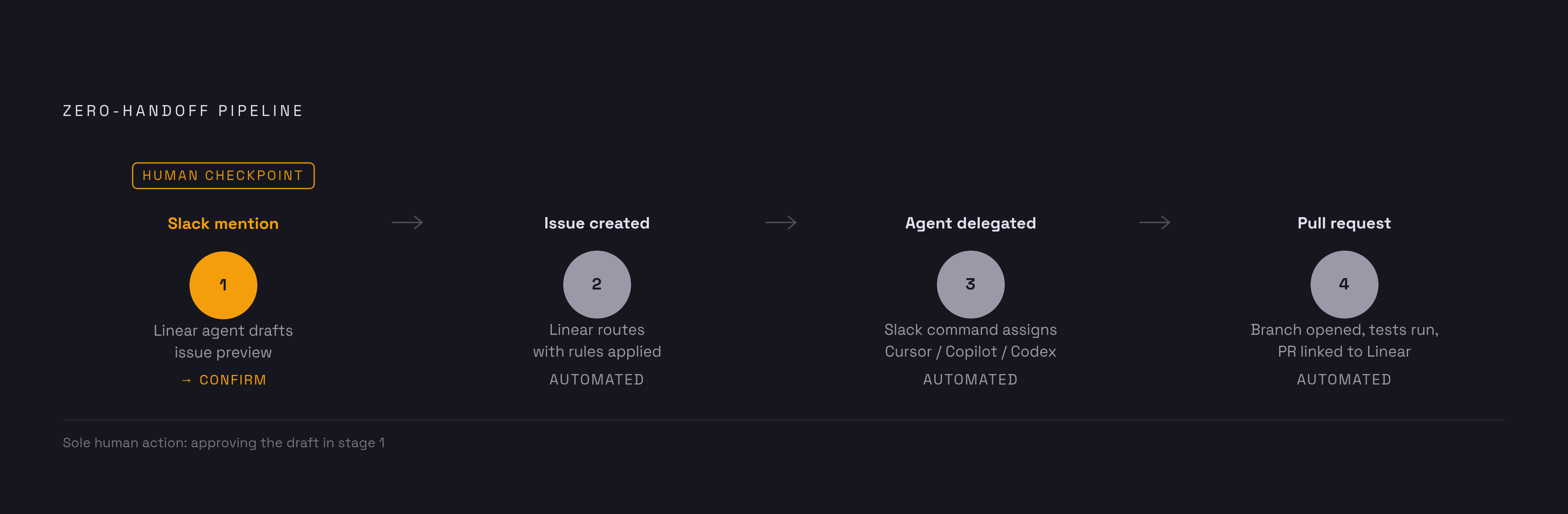
The second hand-off in the pipeline collapses what used to be several separate steps into a single Slack command. Linear's intake layer supports delegating directly to a coding agent at the moment an issue is created, so a message like "@Linear create new issue and delegate to Cursor," "@Linear assign to alex and delegate to Copilot," or "@Linear add to UI refresh project and give it to Codex" does the entire job in one line: it turns the thread into a structured issue and hands that issue straight to a coding agent, with no manual handoff in between.
Which agent to delegate to is a decision made deliberately rather than by defaulting to whichever tool happens to be configured first. Linear's routing supports multiple harnesses, and the right choice for a given task depends on where the code actually lives, what tooling a team has already standardized on, and what the task itself demands. Staying harness-agnostic at this assignment step keeps a team's options open: different task types can go to whichever agent performs best on them, and the team can swap tools as better models ship without rebuilding the whole pipeline around a single vendor. Linear's changelog reflects this flexibility directly, adding deeplinks to AI coding tools, a "Copy as prompt" feature that respects a team's issue status preferences, and a custom local script trigger for opening issues in coding tools, each one a small hook that lets a team customize how an issue moves from Linear into agent execution.
Once delegation happens, the issue leaves human hands. The coding agent picks it up and begins work inside whatever execution environment it's been given, and a poorly built environment breaks the rest of the pipeline.
What the agent needs in its execution environment
A well-written issue, routed correctly and delegated cleanly, can still produce unreliable work if the environment the agent runs in isn't built for the job. Completing a coding task requires more than an instruction: it requires the right dependencies installed, the right credentials available, a filesystem the agent can actually manipulate, and enough tooling access to run tests, install packages, drive a browser if the task calls for one, and verify that its own output actually works. A shared or under-configured environment can't reliably provide any of that. The environment itself is as much a part of the pipeline's design as the routing rules that feed it.
Isolation also matters: each agent run needs its own sandboxed environment, both so that concurrent runs don't collide with one another and so that an agent working on one issue can't reach production systems, export customer data, or push code directly to a main branch. Governance belongs at the point of invocation, not as a patch applied after something goes wrong. An agent should be permitted to open branches, not push to main. It should be permitted to draft pull requests, not merge them. It should be permitted to run tests, not deploy to production. It should be permitted to inspect logs, not export customer data. And it should get read access before it ever gets write access.
Ramp's Inspect agent offers a concrete picture of what this looks like when built properly: it executes inside sandboxed virtual machines on Modal that replicate a full developer environment in the cloud, and it integrates with Datadog, Sentry, LaunchDarkly, Braintrust, GitHub, Slack, and Buildkite. That combination, isolation plus integration, is the template for teams running agents at any meaningful scale: the environment has to be real enough for the agent to do genuine work in it, and constrained enough that the work it does stays safe.
How the agent's work comes back as a pull request
The pipeline's output lands in a reviewer's queue as a pull request, not a suggestion or a draft to be rewritten from scratch. The agent opens a branch, makes its changes, runs its tests, and returns a PR linked directly back to the Linear issue that started the sequence. At that point the engineer's job shifts entirely to review and decision-making, not implementation.
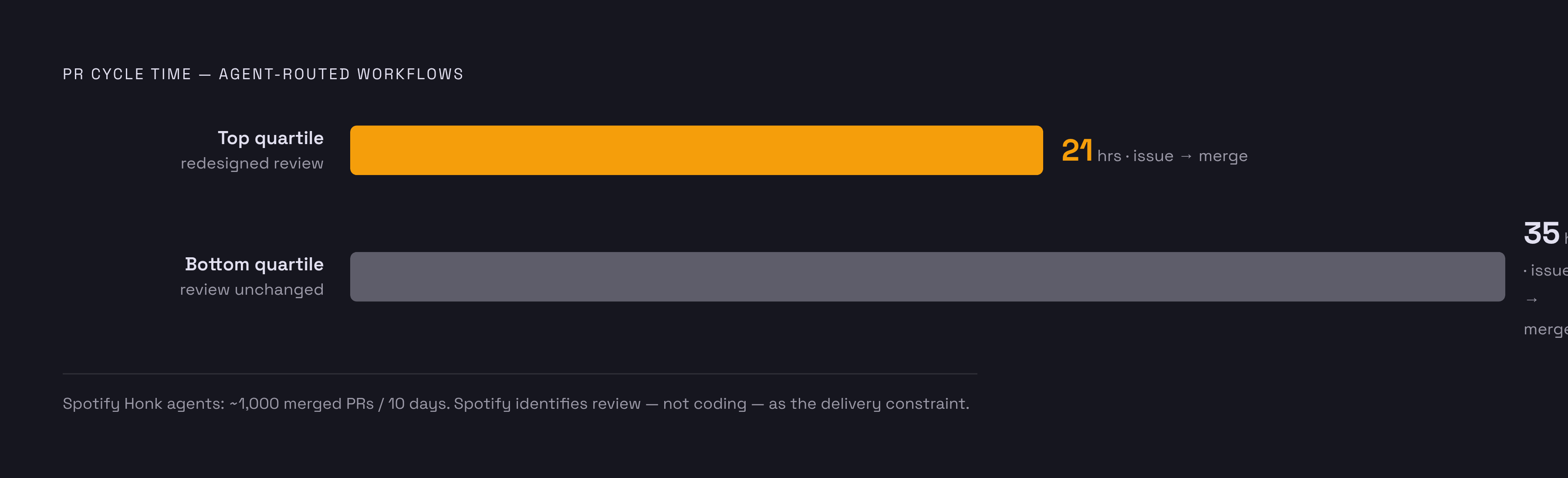
This pattern is already running at real scale. Stripe's Minion agents generate a large volume of pull requests every week from tasks that originate in Slack threads, bug reports, and feature requests, which is a clear signal that PR-returning agents working from structured intake are a production system, not a demo. Spotify's Honk agents, built on a Claude Agent SDK harness, produce roughly a thousand merged pull requests every ten days, and Spotify's own reporting on the system states that the constraint on their delivery speed isn't coding anymore, it's review.
That shift reframes how a team ought to think about building this pipeline. Once agents start generating pull requests at volume, review becomes the limiting factor on how fast anything ships, so if a team scales up agent output without redesigning how PRs get reviewed, cycle times will grow even as raw throughput climbs. Keeping agent-generated PRs small and scoped tightly to the originating issue's acceptance criteria helps directly, and a well-formed Linear issue, the kind the custom instructions above are built to produce, is the best input you can give a well-scoped PR. If agents run their own tests and self-verify before a PR ever opens, reviewers can spend their time judging design and correctness. Linear's GitHub and GitLab integrations link PRs back to their originating issues automatically, preserving the audit trail without extra manual work, and teams benefit from tracking agent-assisted PRs separately from human-only ones so they can see exactly where automation is operating and what it's doing to cycle time.
Security review has to stay in this loop without exception. AI-generated code carries a documented higher rate of common vulnerability patterns than code written by hand, so SAST and SCA checks inside the PR workflow, along with explicit human review of security-critical paths, have to be a mandatory part of the pipeline, not an optional add-on. None of this works, though, without a way to tell whether the pipeline as a whole is actually delivering faster, safer software, which is a measurement problem in its own right.
Measuring whether the pipeline is working: the metrics that matter for agent-routed workflows
Teams often build the pipeline described above and stop there, as if the automation itself were the finish line rather than the start of a system that needs ongoing measurement. A pipeline nobody measures isn't a repeatable system: it's a set of automations running without any feedback on what they're actually producing. Getting that feedback requires attribution all the way down, to the source the issue came from, the harness the agent ran on, and the specific task it executed.
Three metrics in particular reveal whether the pipeline is doing its job. PR cycle time, the span from issue creation to merged PR, separates teams that have redesigned their review process from teams that haven't: top-performing teams complete merges in under twenty-one hours, while bottom-quartile teams running agents without redesigned review workflows take more than thirty-five hours. Issue intake conversion rate tracks what fraction of Slack-originated issues make it all the way through the pipeline to a merged PR without any manual intervention along the way, which is the cleanest signal available for how much of the coordination tax has actually been removed. Context quality at handoff asks whether issues arriving at the agent actually contain acceptance criteria, reproduction steps, and technical context, because an agent working from an incomplete issue produces unreliable output for the same reason an agent working in a broken environment does.
Full attribution, knowing which agent, which harness, which model, and which source produced each run, is what lets a team improve the system over time instead of merely operating it, the same principle that makes an environment like Ramp's Inspect useful beyond a single deployment. The pipeline traced in this article, from Slack mention through Linear issue through agent delegation through pull request, is a starting configuration, not a finished product. Routing rules, custom instructions, and agent assignment logic all need regular review as harnesses improve, task volume grows, and new intake channels get added to the mix. The metrics are what tell a team when that review is due.