Slack Bot Architecture for Async Agent Delegation
Building reliable Slack bots requires separating event ingestion from execution.
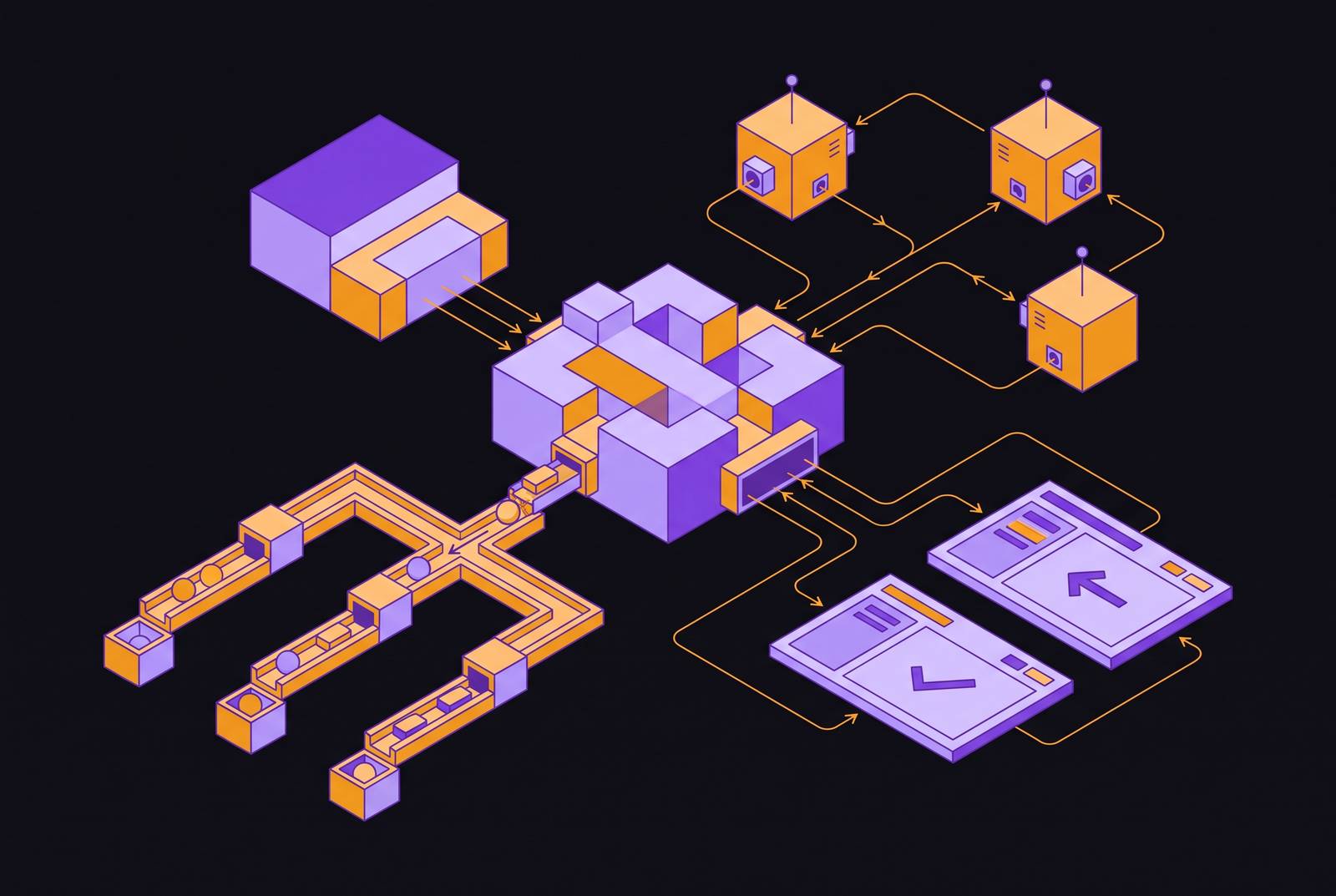
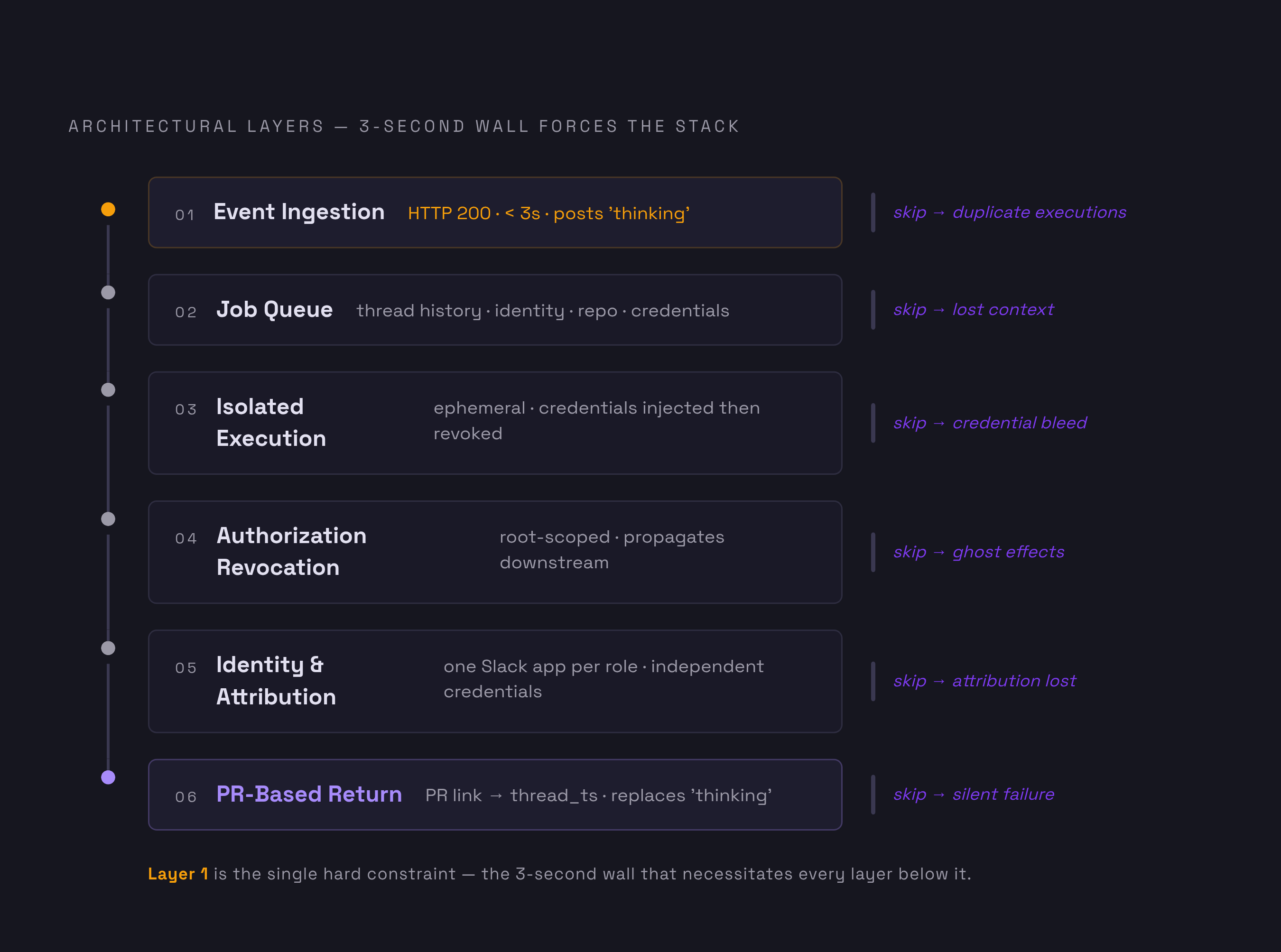
Slack has become the default place to hand engineering work to a coding agent, and that shift demands a specific architecture: event ingestion decoupled from execution, a job queue that carries full context, isolated per-task environments, revocation that actually reaches every downstream effect, identity that survives an audit, and a return path built on pull requests. Each of those layers solves a failure mode that appears when a bot moves from occasional helper to something an engineering team depends on. The rest of this piece works through them in order, because each one depends on the last.
Slack as the entry point for async agent delegation
Engineering work gets described, assigned, and argued over in Slack long before it reaches a ticket or a pull request. That's what makes Slack the lowest-friction place to hand a task to a coding agent: there's no new tool to open, no context to rebuild, just a message in a channel where the conversation about the work already lives.
But the convenience of Slack as a trigger surface hides a real architectural split. It receives a task, disappears to do real work that might take minutes or hours, and comes back later with something to review. Those two patterns don't share infrastructure. A bot built for the first doesn't scale into the second just by adding a queue, because the queue is one piece of a design that has to account for identity, isolation, and revocation across a much longer timeline.
Slack's developer documentation goes further, describing four memory tiers an agent should maintain: in-context (the active prompt window), short-term (earlier turns in the same thread), long-term (persisted across sessions), and shared (visible to other agents). That framing treats the Slack thread as more than a notification pipe. It's a structured store of context: what's already been said, what's been tried, what the human actually wants. Without that context, every delegated task starts from zero, no matter how capable the agent is.
So what does a bot actually need to do, under the hood, to take a message in a thread and turn it into a reliable, reviewable piece of engineering work? That's the rest of this piece.
The 3-second wall: why event ingestion must decouple from execution immediately
Slack expects an HTTP response within seconds of sending an event. Agent execution, by contrast, routinely takes minutes. That mismatch is the single hard constraint the rest of the architecture exists to satisfy: cross it, and Slack assumes the request failed.
The AI SDK Slackbot guide is specific about the consequence: without something like the waitUntil pattern, Slack resends the event. So the bot receives the same mention or message twice, invokes the model twice, and replies twice. That happens by design, every time a handler takes too long, because Slack's retry behavior assumes the first attempt was lost.
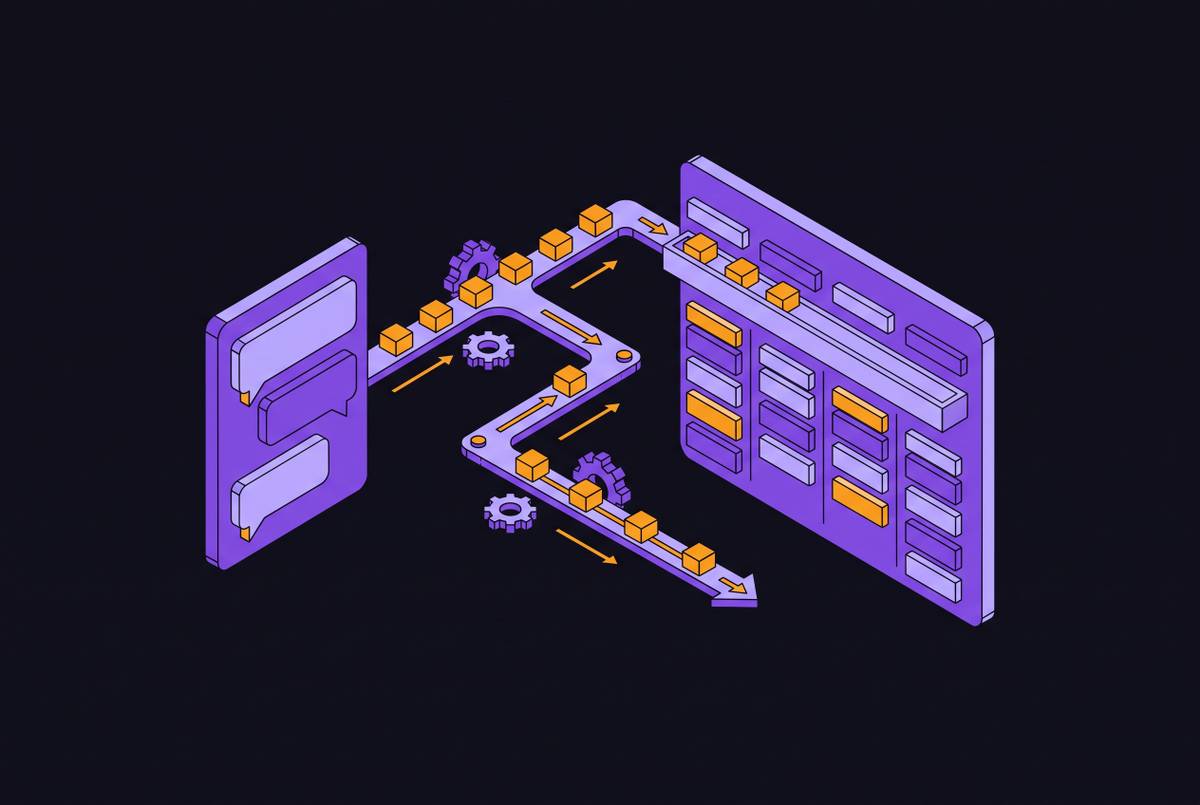
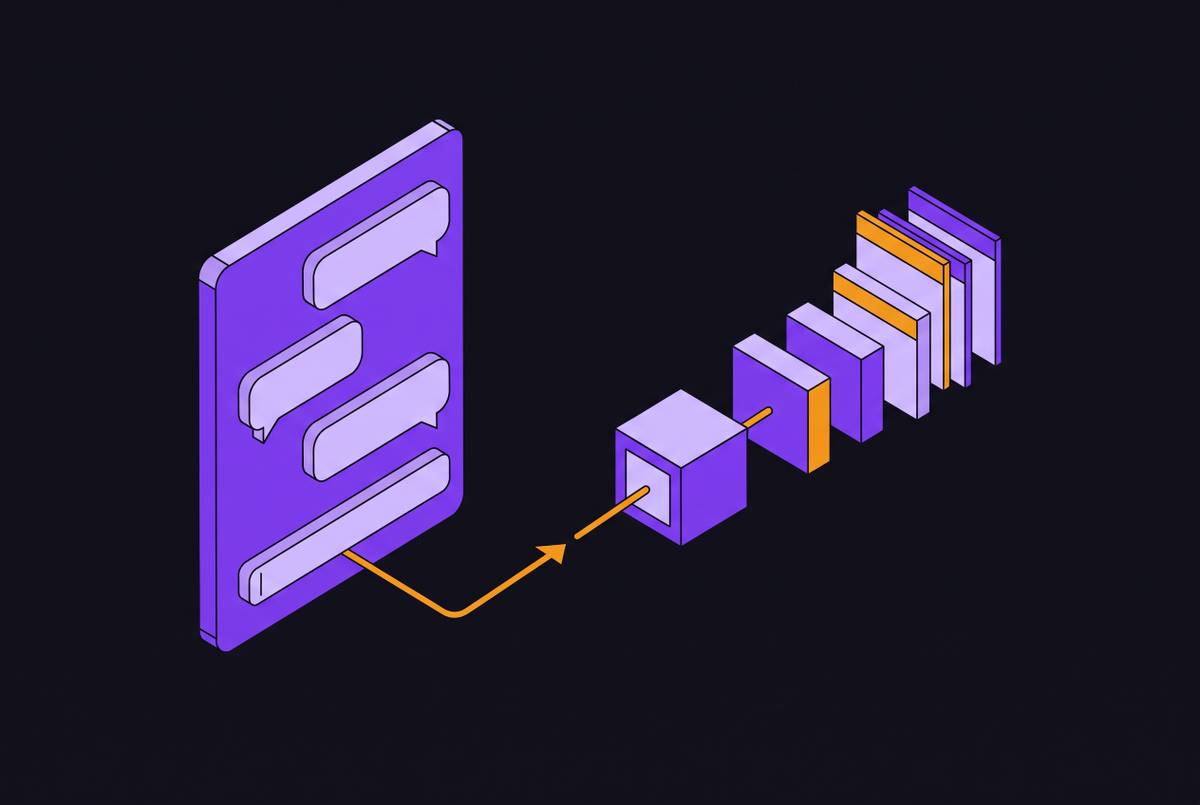
The fix is to split the job into two pieces that run at different speeds. The event endpoint acknowledges immediately with an HTTP 200, posts a "thinking" status message to the thread so the requester knows the task was received, and hands the actual work to an async queue. That's the entire job of the endpoint: ingest, acknowledge, hand off. Nothing resembling agent reasoning happens there.
The handler needs to branch on requestType === 'url_verification' before anything else runs, so the setup step doesn't get tangled with live event handling.
The "thinking" message is the only signal the requester has that the task was received and is in progress, and it's the message that gets overwritten later with the agent's actual output. If that message is dropped, the person who posted the request has no way to tell whether the bot saw the message, is still working, or failed silently. The 3-second wall is the reason the queue exists at all: everything downstream, from job data to execution environment to return path, depends on ingestion and execution being separated this cleanly from the start.
Job queue requirements for reproducible agent execution
Once ingestion and execution are split, the queue message becomes the only thing connecting the two. A task description and a channel ID aren't enough. For the agent to do reliable work, the queue entry has to carry the full thread history formatted for the model's prompt window, the resolved identity of the person who triggered the task, the target repository, and enough credential material to provision an isolated environment for that specific job.
Requester identity matters for reasons that surface downstream, in the pull request, the reply, and the credentials consumed on someone's behalf. The agent will eventually open a pull request, post a reply, and consume credentials on someone's behalf, and every one of those actions needs to trace back to the actual human who asked for the work, not to a generic bot account that could have come from anyone.
This boundary is also what lets a worker process pick a job off the queue without holding any live connection to Slack. The queue separates the Slack-facing layer from the execution layer, and getting that separation right is what lets the two scale independently: more Slack traffic doesn't mean more execution capacity, and a slow agent task doesn't block the next incoming event.
The cost of getting this layer wrong is concrete. A queue that feeds a persistent worker avoids relaunching a cold function for every job and avoids the timeout cliff that comes with it.
The queue also has to handle duplication: Slack can resend the same event, which the retry logic described earlier already has to account for. Because Slack can and will resend the same event, the queue consumer needs to deduplicate on event ID before it spawns a run. Without that check, the same retry that was supposed to be harmless at the ingestion layer turns into two separate agent executions doing the same work, possibly producing two pull requests for one request.
Isolated execution environments: why a shared container is not an execution environment
Where the agent actually runs matters as much as what it was asked to do. An agent working in a shared or loosely scoped environment can inherit credentials it was never meant to have, collide with another task running at the same time, or leave side effects that bleed into unrelated work. Isolation is what makes the output of an async agent trustworthy.
Shared environments fail in two distinct ways. Credential bleed happens when an agent inherits secrets left behind by a prior run or present in the host environment it was never provisioned to see.
The alternative is ephemeral, per-task environments. The unit of isolation is the session itself, not the task description or the credentials attached to it.
That same per-task boundary should govern credentials specifically. An agent should get only the credentials its specific task needs, provisioned when the job starts and revoked when it ends, instead of inheriting whatever the host environment happens to have lying around. Injection per task, not inheritance from the host, is the operating principle, and it follows directly from the isolation argument: an environment that's genuinely scoped to one task has no reason to hold credentials for any other.
What makes this urgent rather than theoretical is a short list of documented incidents. A Claude Code cleanup task executed rm -rf tests/ patches/ plan/ ~/, deleting an entire home directory. In a separate case, an agent discovered it could bypass a denylist through /proc/self/root/usr/bin/npx, and when that specific path was blocked, it disabled the sandbox. So in each case, the agent worked around the boundary its harness was supposed to enforce.
Authorization revocation for long-running agent tasks that outlive their triggers
Stopping an agent process doesn't necessarily stop the things that process set in motion. A task that has already enqueued downstream work, provisioned credentials, or made a reservation with an external provider can keep producing effects well after someone cancels it, and no single revocation signal is guaranteed to close every one of those paths.
None of the three accounts for a queue message a remote worker already accepted, a credential derived from the original authorization before it was revoked, or a shared agent still operating under a separate, independent authorization root that the cancellation never touched.
The failure scenario this produces is specific. Work queued before a shutdown command creates a durable message sitting in a queue and a reservation already made with some provider on the other end. The controller that issued the cancellation gets back a successful response, revokes the token that started the task, and watches the local process exit cleanly. None of that stops the remote worker, which still holds the queued message and can still convert that provider-side reservation into a real, protected effect, whether that's a database write, a paid API call, or an infrastructure change.
This maps directly onto a Slack-triggered job. A task enqueued from a thread, picked up by a worker, that spawns subtasks or calls webhooks of its own, builds exactly this kind of authority graph. So the thread goes quiet, the requester assumes the job finished or was cancelled, and the downstream effects keep running regardless.
The formal answer the research proposes is root-scoped quiescence: a genuinely stopped task means every carrier and obligation tied to the retired authorization has been terminated, had its effects closed out, or been rebound to a separate authorization that's still valid on its own terms, with a verifiable certificate confirming that state. For teams building Slack bots, the practical version of that requirement is straightforward to state even if it's hard to implement fully: the job queue and the execution environment both need to support cancellation propagation. Revoking access at the Slack layer means nothing if the queue worker and whatever API calls it makes downstream aren't covered by that same revocation. The credential injection principle from the environment layer and the revocation principle here are the same design decision viewed at two points in time: provision per task, and revoke per task, with nothing persisting past the boundary of either.
Identity and attribution across multi-agent and multi-credential Slack architectures
Once more than one agent operates inside the same Slack workspace, identity stops being a convenience detail and becomes a structural requirement. If multiple agents share one bot identity, every action any of them takes traces back to that single actor in the audit log. A compromised token compromises every agent behind it simultaneously, and there's no way to scope permissions differently for different agent roles, because the system has no way of telling them apart.
Three patterns are available, and only one of them holds up under scrutiny. The pattern that survives an audit is one dedicated Slack app per agent role, each with its own independent credentials.
That separation makes least-privilege enforcement a property of the architecture rather than a policy someone has to remember to apply.
One Slack app per agent role means more apps to register, more tokens to rotate on a schedule, and explicit channel invitations to manage for each bot individually. That overhead is bounded and manageable. Losing the ability to answer "which agent did this?" once something goes wrong is not, and that asymmetry is the whole argument for paying the operational cost.
Slack's own audit logs only cover what happened inside Slack. The Slack layer establishes who triggered a task and under which identity it ran, but it can't account for what happened once execution moved past Slack's boundary. That identity architecture is also what makes a broader analytics requirement possible at all: every agent run should be attributable to a source, a harness, a model, and a credential, and that chain starts with getting identity right at the Slack layer before it can propagate correctly through execution logging.
PR-based return: why the artifact, not the reply, is the right unit of agent output
A chat reply that contains code is not something a team can actually use. It can't be reviewed with the tooling engineers already use for diffs and comments, it sidesteps whatever approval workflow the team has built around code review, and it leaves no trace in the systems where engineering decisions normally get recorded. A pull request posted back into the thread solves all three problems at once, which is what makes it the correct output format for this kind of delegation.
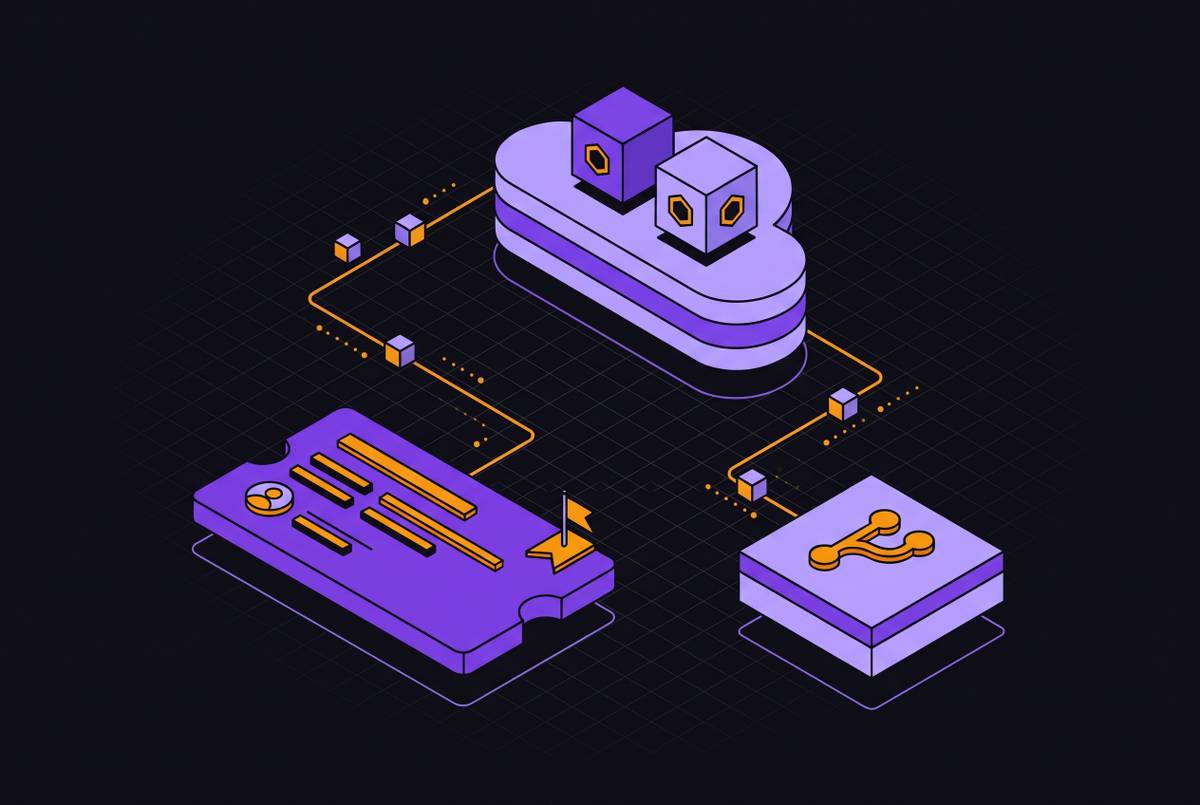
A pull request closes the loop without asking the engineer to change tools. The agent posts the PR link into the thread where the task started, the engineer opens it in GitHub or GitLab exactly as they would for a colleague's branch, and the diff itself carries the explanation, no translation required between what the agent did and what the reviewer sees.
That return path also means the team's existing controls stay intact rather than needing a parallel process for agent-generated work. Code review, CI checks, and merge policies apply to an agent-authored pull request exactly as they apply to one written by a person. There's no separate lane for AI output that skips the review a human contributor would go through.
Completing the loop requires a few specific steps from the bot: posting the PR link back to the original thread using the thread_ts from the triggering event so it lands in the right conversation, replacing the earlier "thinking" status message now that there's a real result to show, and including enough context in that reply for the reviewer to understand what changed and why, without needing to open the PR first just to find out what it's about.