Why Linear Is the Right Place to Own Agent Dispatch When Tasks Need Isolated VMs and Audit Trails
Linear issues can anchor agent intent, ownership, and review while isolated VMs record execution.
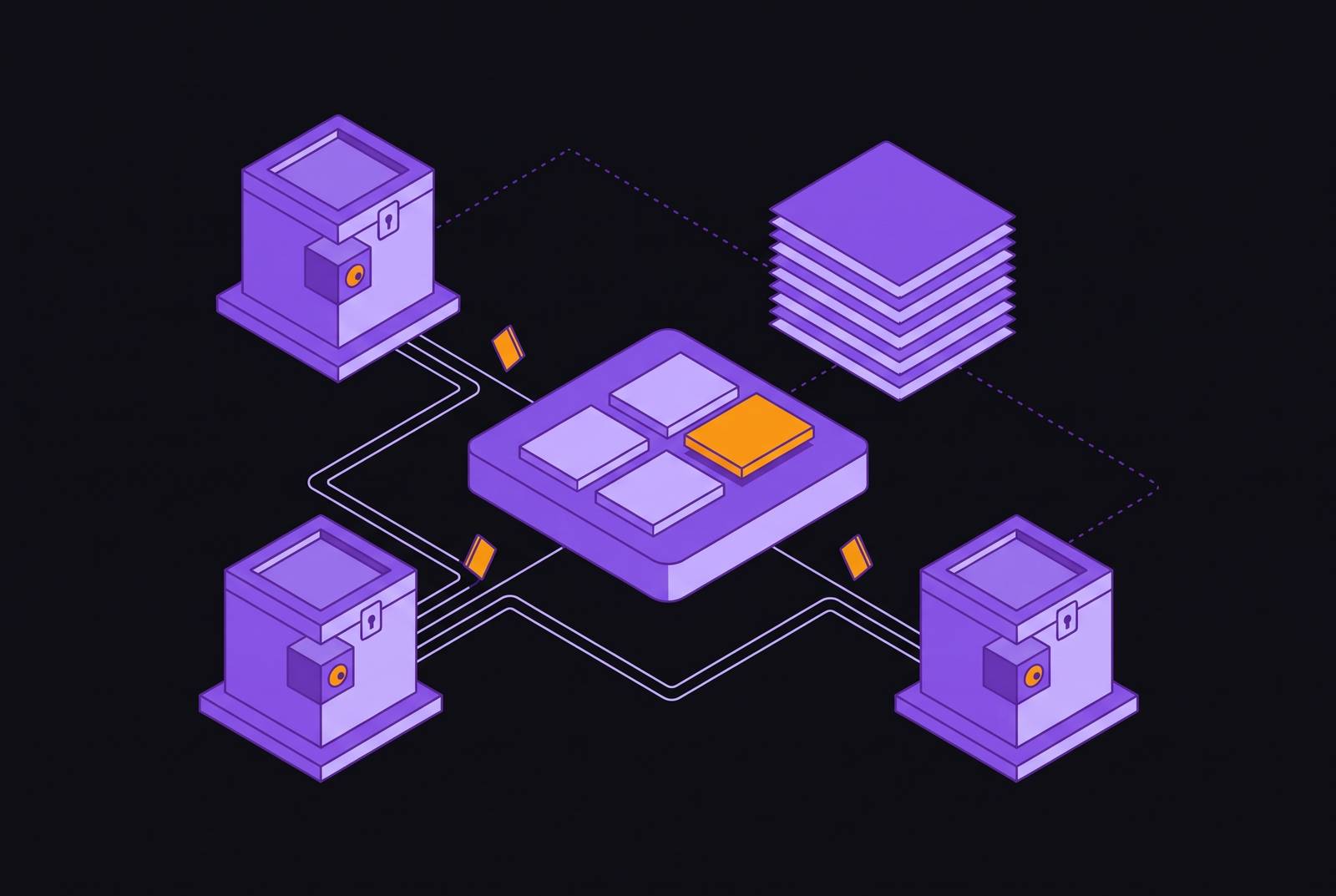
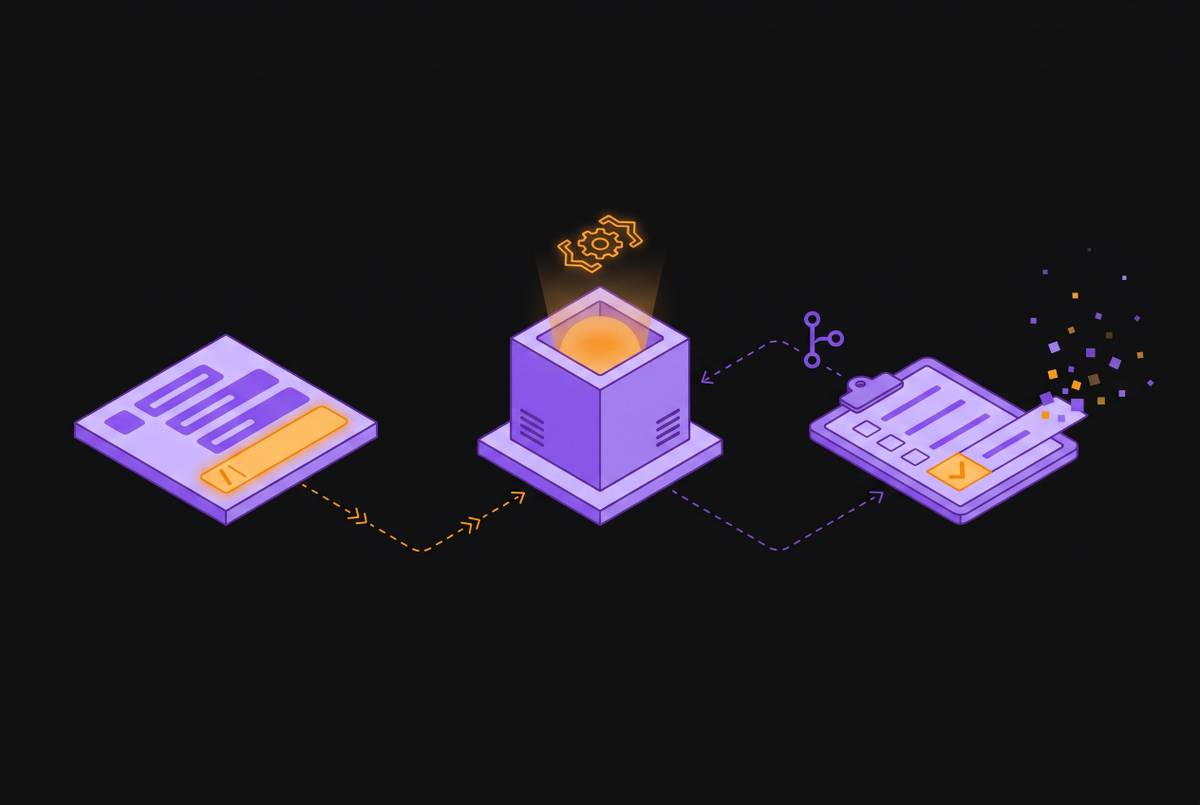
Linear and Slack integration for autonomous coding agents works best when Slack starts the request, a Linear issue owns the assignment, and an isolated cloud VM runs the code. Linear can dispatch work through external agents, a team-controlled harness, or its own Claude Code or Codex coding sessions. The issue should anchor intent and review, while the execution layer records what the agent did.
Why the issue tracker is becoming the control plane for agent work
The traditional ticket was a handoff artifact. A PM wrote a specification, it waited in a backlog, and an engineer picked it up. Agents change that relationship because they need execution context without waiting for sprint planning. Agents use descriptions, discussions, linked customer requests, and cycle history to do the work that humans once read them to understand.
That shift makes assignment a governance decision. The system must connect what was requested, who owns it, what an agent may do, and how its output will be reviewed. Chat can initiate a request, and CI can run code, but neither alone assembles that whole record. The issue tracker’s advantage is its existing relationship between task intent, ownership, and acceptance.
What Linear's pivot to agent management signals about the broader shift
Linear’s March 2026 pivot made this shift concrete. Linear reported that coding agents were already installed in a large majority of its enterprise workspaces, while agent-driven work volume had multiplied fivefold in three months. Up to a quarter of new issues in those workspaces were being created autonomously. Agents were becoming participants in the assignment system.
Linear’s June 2026 announcement moved that participation into implementation. Coding sessions using Claude Code or Codex could investigate an issue, write a fix, and open a pull request, returning the diff for review inside the workspace. By late 2026, Linear described itself as “a product development system for teams and agents designed for planning and building products with AI agents”. Planning and execution now shared a task record.
The five routes from a Linear issue to running agent code
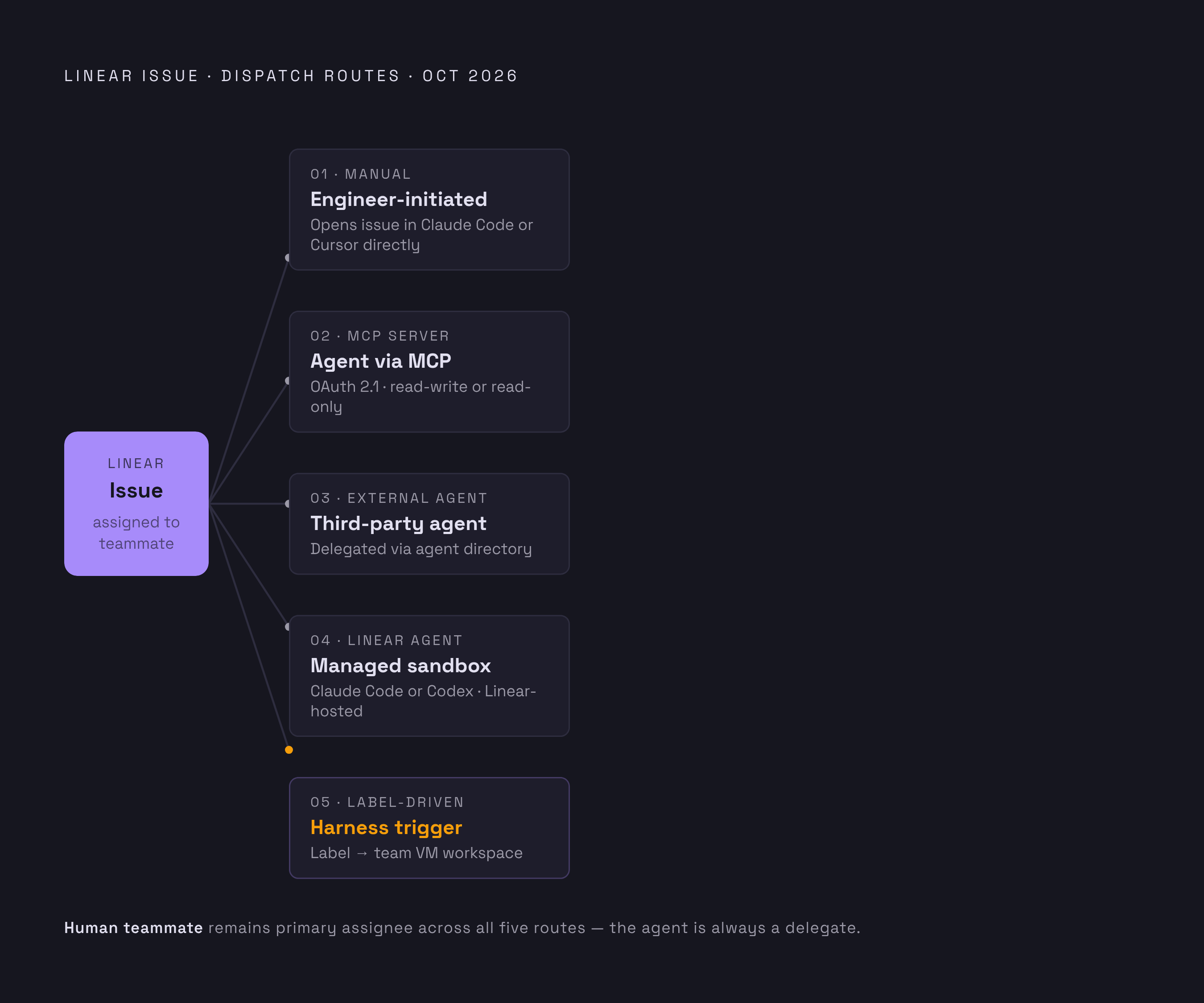
As of October 2026, Linear supported five dispatch paths. The first was manual, with an engineer opening an issue directly in a coding tool such as Claude Code or Cursor. The second granted an agent access through Linear’s hosted MCP server, authenticated with OAuth 2.1. Read-write access supported changes to issues, while a read-only endpoint served agents that needed context without permission to alter it.
The third path delegated an issue to an external cloud agent from Linear’s agent directory. The fourth delegated to Linear Agent itself, which ran coding sessions through Claude Code or Codex in a managed sandbox. The fifth used a label-driven harness to turn issues into prepared agent workspaces on infrastructure the team controlled. These routes put execution in different places.
Ownership nevertheless remained with a human teammate. As of October 2026, the teammate stayed the issue’s primary assignee while the agent acted as a delegate. Business and Enterprise triage rules could delegate incoming issues without a person having to dispatch them. That distinction separates accountability for the task from the act of starting execution.
Why isolated cloud VMs are a prerequisite, not an optional upgrade
Dispatch automation increases the need for an execution boundary. An unmanaged local session does not provide the centrally enforced containment, network policy, residency controls, and independent evidence required for governed agent work. A cloud-managed sandbox can contain a compromised agent within its environment and impose hard limits on CPU, memory, disk I/O, and bandwidth. Network access can be scoped per session. Tool calls, process starts, and network attempts can also be recorded outside the guest.
The word sandbox alone does not establish isolation strength. Containers use Linux namespaces for process isolation but share the host kernel, so a kernel vulnerability can expose other containers on that host. MicroVMs run separate operating systems and kernels through hypervisor technology such as Firecracker. Their hardware-enforced boundary separates compromised guest code from other environments. The kernel boundary is the decisive distinction.
Management responsibility also needs to be explicit. Claude Code on the web runs sessions in isolated, Anthropic-managed VMs with network access limited by default. Linear Agent’s coding sessions run in cloud environments that Linear manages. Those are not interchangeable infrastructure claims. As individual adoption of Cursor, Claude Code, and GitHub Copilot outpaces organizational controls, that distinction helps separate approved execution from shadow AI with inconsistent access rules and no dependable audit record.
What a defensible audit trail for agent work actually requires
A diff shows the result. A defensible record must identify who ran the session, which agent and model were used, what the intent was, which files were touched, and what changed. It must then connect that session to the pull request, review, and approval gates. SOC 2 requires evidence that controls operated consistently across the audit period, rather than a screenshot showing that a control existed once.
The supporting controls extend beyond activity logging. They include SSO integration, SIEM-connected audit logging, secret scanning on agent-produced PRs, PR policy gates, license governance, sandbox isolation, and incident response runbooks. Linear gives teams some control over who has access through Enterprise-managed MCP access. Enterprise workspaces with Okta SAML can place MCP sign-in behind Okta’s policies. Teams still need to set up secret scanning and incident response runbooks separately.
If the record exists only in one agent’s console, switching tools can break the continuity needed for investigation. Recording execution at the VM layer and linking session IDs to Linear issue IDs addresses that risk. That preserves the relationship between intent and outcome independently of the harness.
How Linear's issue structure gives agents the context that makes governance work
The issue assembles the information needed to judge both execution and outcome, making it the right dispatch unit. Acceptance criteria define success without requiring an engineer to rewrite the task as a separate prompt. Discussion preserves earlier decisions and objections, while linked customer requests explain the business purpose. Cycle and project history constrain scope. A chat message or CI trigger alone lacks that assembled context.
Linear reports using agent-driven triage and coding sessions internally to resolve roughly a third of incoming bug reports, mostly on the first pass. Sparse descriptions leave agents with vague instructions, while detailed acceptance criteria give them a defined target for a mergeable PR. Reviewers can use the same criteria to decide whether to accept or reject the change. Linking the issue, session, and PR makes the reason for the change visible beside its implementation.
Linear’s Loops can review issues, dispatch agents, and keep project specifications current on a schedule or event. They also mark whether text came from a colleague or an automated loop.
How can teams trigger autonomous coding agents from Slack messages?
Slack can be the entry point without becoming the assignment ledger. With Linear’s integration, teams can create and triage issues from a chat thread without opening Linear. When someone mentions Linear Agent in a channel, it responds using context from the workspace, and Enterprise supports multiple Slack workspaces and private channels. To reach coding execution, the resulting issue connects to a delegation rule or another dispatch path. A mention alone is not the whole workflow.
The review loop remains attached to that issue. GitHub and GitLab integrations automatically link pull requests, support correctly formatted branch names from issues, and can move or close an issue when its PR merges. This connects chat-originated work to the code review record. Engineers do not need a separate task history simply because the request began in Slack.
Alerts can enter the same governed route. Sentry or Firebase events can create bugs in Linear, and an agent can use MCP connections to Sentry or Datadog to investigate root cause before proposing a fix. The sequence runs from alert to issue to agent session to PR. Whether work begins in chat, an alert, a triage rule, or a schedule, the issue remains its common anchor.
What running agents in cloud VMs outside Linear adds to the governance model
Linear owns dispatch and the reviewable task record, while the cloud VM platform supplies isolation and session-level evidence. For teams needing harness portability, that separation allows Claude Code, Codex, or Cursor to change without replacing the dispatch workflow. Session IDs remain linked to issue IDs. The audit record need not depend on the current coding tool.
The relevant platform criteria extend beyond VM availability. They should look for session recordings and tool-call logs kept outside the guest, access to models through the team’s own accounts and keys, and per-workspace-minute billing that stops while workspaces sleep. SCIM, audit logs, and self-hosting options meet other needs that organizations may have. These execution-layer capabilities require assessment independently of a Linear integration.
The trade-off is an additional system to operate. With Linear’s native sandbox, teams have no separate platform to run, but they can see its session-level logs only in Linear’s console. Teams that need harness portability, self-hosting, or independent SIEM integration thus need an execution layer they control.
Pricing and cost structure across Linear dispatch paths
Agent dispatch has separate platform and execution costs. Agents do not consume billable Linear seats, and third-party compute and model charges are paid separately to the agent vendor. As of October 2026, Linear’s own Coding Sessions and Loops used prepaid AI credits. Coding sessions charged model tokens at the provider’s published rates without markup, plus sandbox runtime in 20-minute increments. A known rate still does not establish the total cost of an open-ended session.
Linear’s documented tiers also affect available controls. Free has no charge and includes unlimited members, up to 2 teams, 250 active issues, and Linear Agent chat and Skills during beta. Enterprise has custom pricing and adds SAML/SCIM, HIPAA compliance, IP restrictions, an audit log, priority support, and an uptime SLA. The controls a team needs can decide which platform tier it chooses, regardless of how much it uses agents.
Cognition’s Devin illustrates a different execution meter. One ACU is a fixed window of time spent on active autonomous work, and small tasks with a clear scope usually cost under 1 ACU while medium features use several. Large or vague tasks can consume many without producing a mergeable PR. ACU billing was retired for self-serve customers in April 2026, while Enterprise uses ACUs at a custom rate. Its Teams plan bills for usage, with a minimum spend and a monthly charge for each full developer seat.
Forecastability depends on scope as well as billing units. Where ACUs are available, teams can use them to plan ahead, while workspace-minute pricing charges for active compute and token-based costs depend on how much the model is used as the work runs. None makes a vague task finite. Detailed acceptance criteria are therefore a cost control because they reduce ambiguity that can prolong a session without improving its output.
What to put in place before dispatching agents at scale from Linear
Before teams delegate backlog items, they should add a line about what each item will do for the customer and clear acceptance criteria. Code ownership and repository access rules should also be settled before the first session. Payments, login credentials, and customer data should stay in systems that humans control and out of the work delegated to agents.
Access policy must match the agent’s role. Enterprise teams with Okta SAML should configure MCP authorization through Okta, while agents that only need context should use the read-only endpoint. The execution review should check whether the chosen path runs in an isolated VM or a shared container. It should also confirm that session logs live outside the guest and that session IDs link to issue IDs independently of the harness.
Teams need to set a monthly spending limit before the amount of work grows. Where available, Devin’s ACU model supports advance planning around active-work units, while token-based tools fit work whose session length is predictable from scope. The final production gate is reviewable output. Every session should produce a PR linked to its originating issue that a human can merge, comment on, or send back.