Invoking Cursor or Claude Code as a Cloud Agent From the Ticket Where the Work Was Assigned
Teams can now trigger cloud coding agents directly from tickets and receive pull requests.
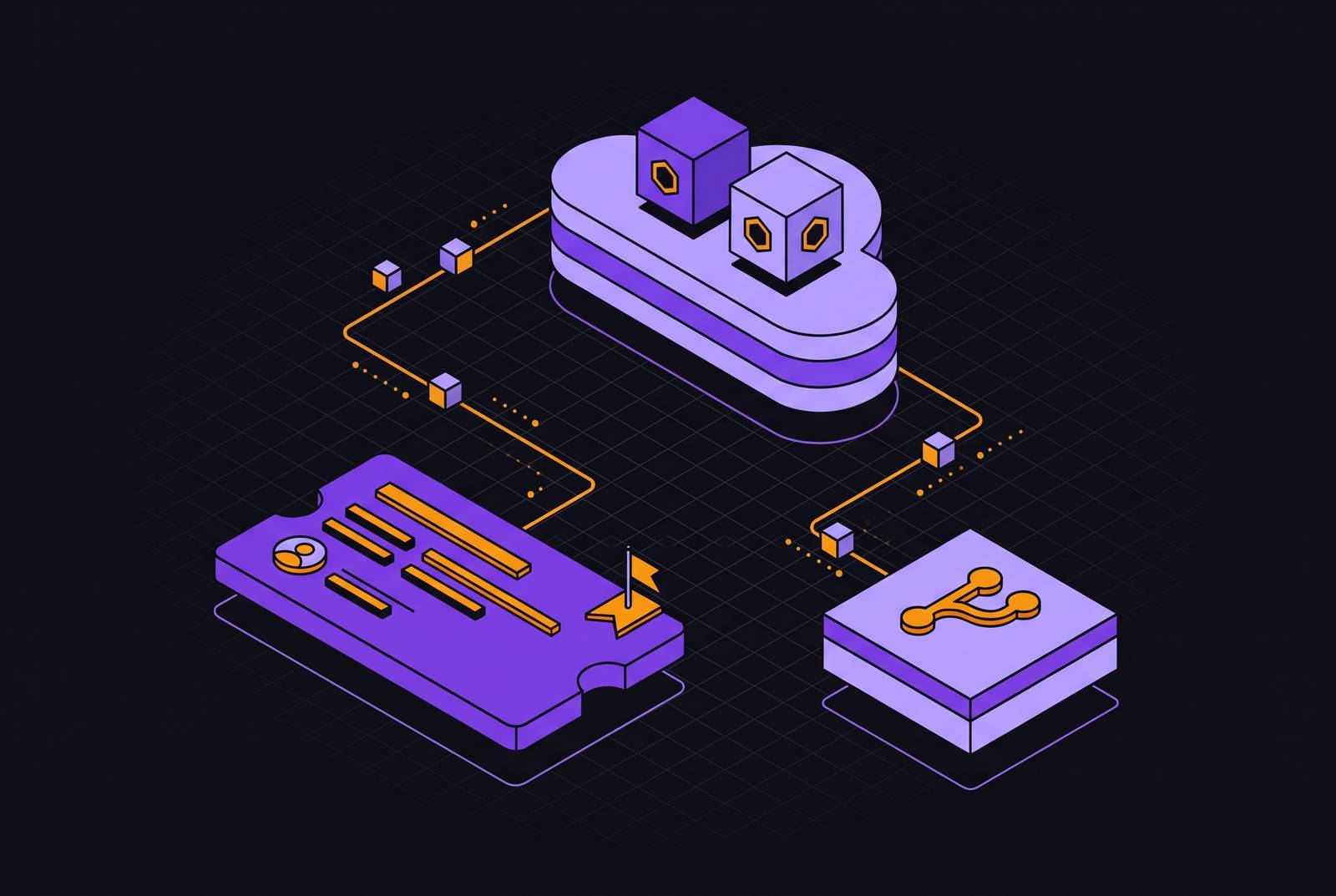
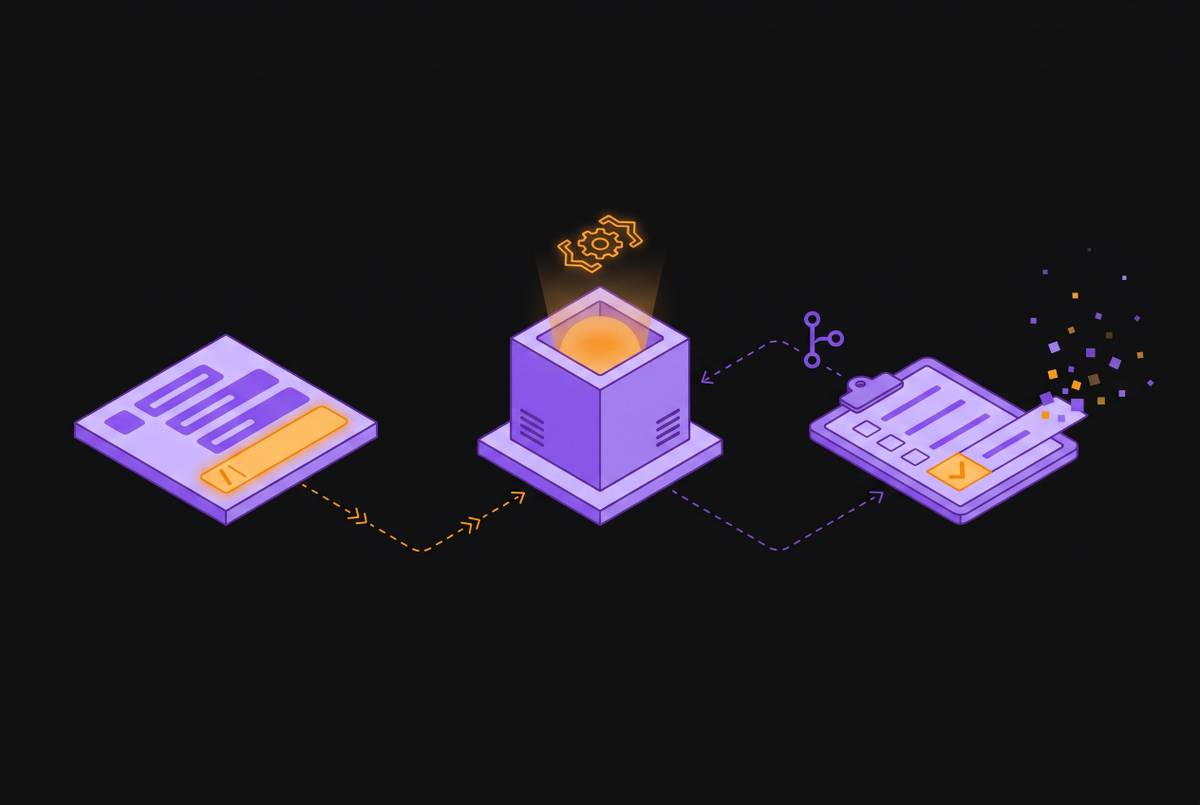
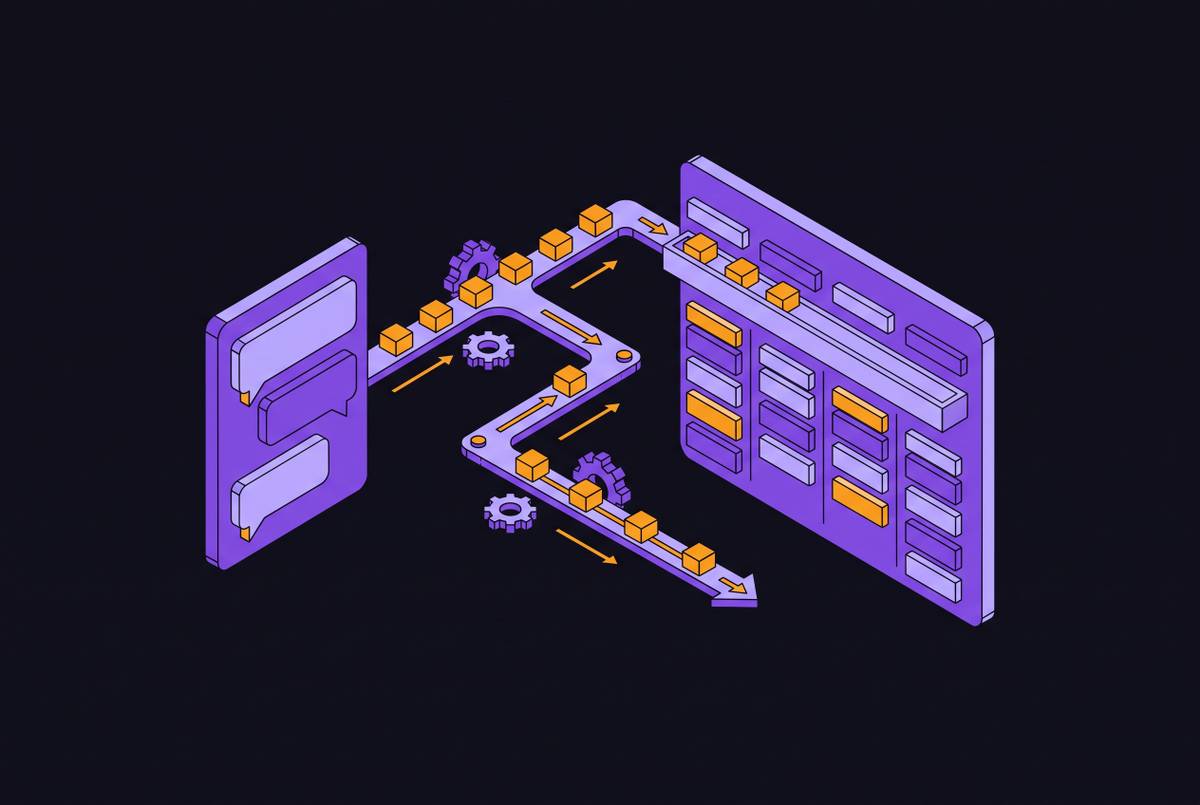
A multi-harness cloud coding agent platform connects Linear, GitHub, GitLab, or Slack to isolated execution environments where Cursor, Claude Code, Codex, or Opencode can run tasks and return pull requests. It lets teams delegate work across harnesses without managing each agent’s execution infrastructure. Closing the loop between assignment and review turns the ticket into an executable handoff, eliminating the need to copy it into another prompt.
Why ticket trackers are becoming agent dispatch surfaces
The three-layer stack emerging in 2026 separates real-time pairing in the IDE, local execution through the CLI, and asynchronous delegation to cloud agents. Each serves a different intent. IDE assistance helps an engineer who is writing code, while cloud delegation lets an engineer hand off a task and review the result later. Bug fixes, dependency upgrades, test authoring, and mechanical refactors fit the latter model because they can be bounded and reviewed.
Ticket trackers already organize that kind of work. What changes their role is a dedicated agent-session API that connects a ticket’s trigger, the execution handoff, and the pull request return. JetBrains’ Developer Ecosystem Survey 2026 found that 90% of professional developers use cloud or local agents weekly. Agent use is therefore mainstream, but the infrastructure connecting assignment to execution is still catching up for many teams.
What "closing the loop" actually requires technically
An agent-session API accepts a task description, a repository reference, credentials, and a callback target for the pull request destination. Without that interface, the tracker and agent are separate workflows, even if it takes little effort to move between them. The API establishes the handoff. The session also needs an environment in which the agent can install packages, run tests, drive a browser, and verify its output.
That environment needs a defined security boundary. Isolation technologies include gVisor containers, Firecracker microVMs, and Linux containers, but their boundaries differ. Firecracker uses Linux KVM for hardware-level isolation, giving each session its own guest kernel, while containers share the host kernel. A read-only context window cannot provide the execution capabilities above, while a shared sandbox does not provide the same separation between sessions and host infrastructure.
Before execution, the session needs the team’s dependencies and tooling, relevant repository context, and project-level rules or memory files. These can include AGENTS.md, CLAUDE.md, and project rules. The ticket body gives the agent background prose and is also an input parameter. Claude Code caps tool output at 25,000 tokens by default, so exploring more than needed uses up the context budget. At the other end, the output contract must deliver a pull request, recording, or structured reply into the review workflow, moving the result beyond a diff in a chat window.
How can a ticket invoke Cursor or Claude Code? The three live paths
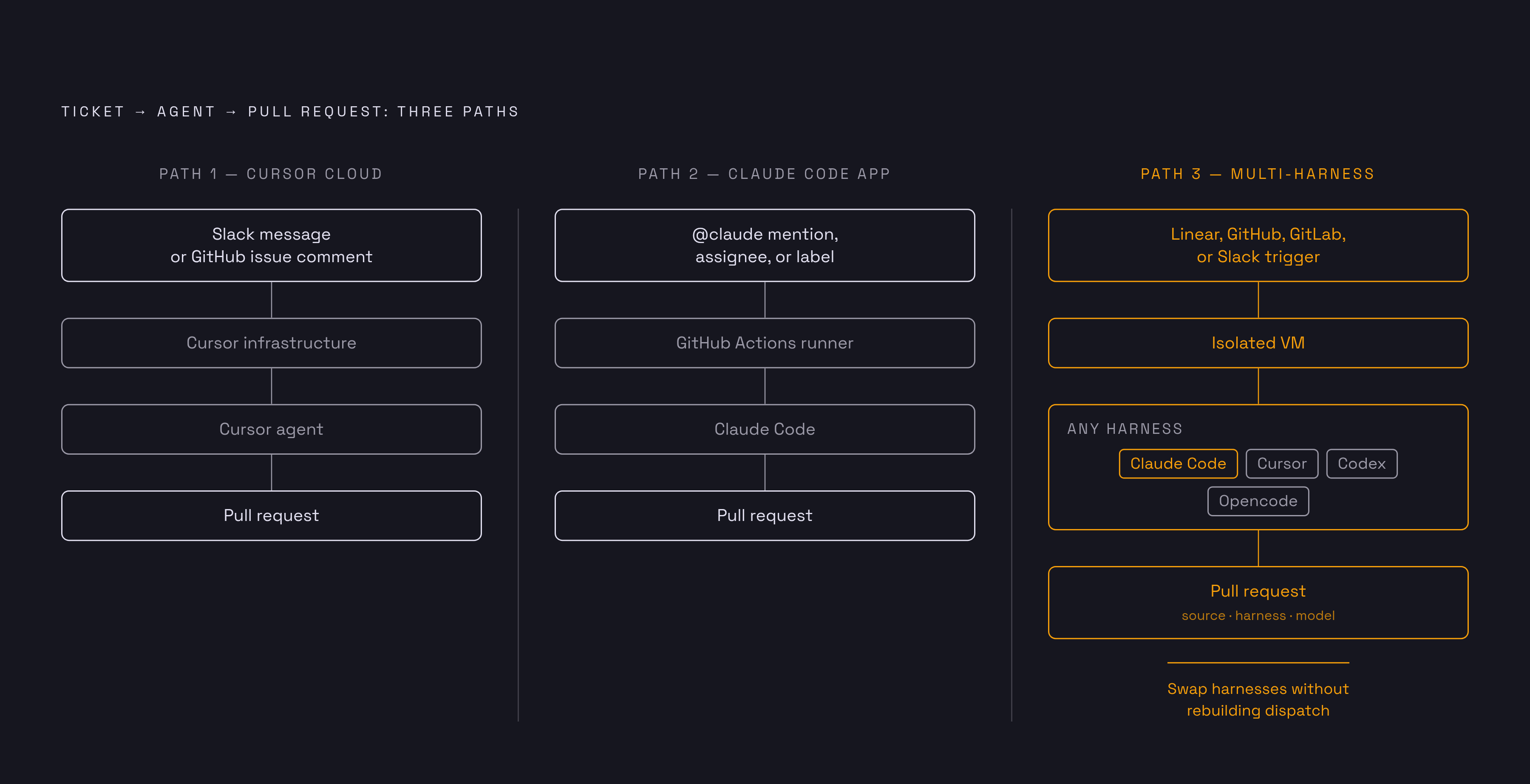
Cursor’s cloud agent provides the first path through Slack or GitHub, with additional launch surfaces in its desktop app, web interface, and mobile interface. A Slack message or GitHub issue comment can trigger a session. The agent can build software, test changes, interact with desktop applications, record video demos, and produce merge-ready pull requests. This is the most integrated route for teams already using Cursor. It connects delegation to the same ecosystem rather than requiring a separate choice of execution harness.
Cursor launched long-running agents on February 12, 2026, for Ultra, Teams, and Enterprise users. These agents can work autonomously for extended periods and produce pull requests with very large changesets. Cursor Projects, launched September 10, 2026, adds a coordinator layer for work that outlasts a chat thread. Its persistent context and recurring triggers make it a background delegation surface.
Claude Code’s GitHub App and Actions workflow provides the second path. After installing the app and adding a workflow file, an engineer can mention @claude in an issue or pull request comment, or in a new issue’s body, to start a run on a GitHub-hosted runner. The Action also exposes assignee and label triggers. A run can therefore start when a ticket is assigned or labeled, without a separate prompt.
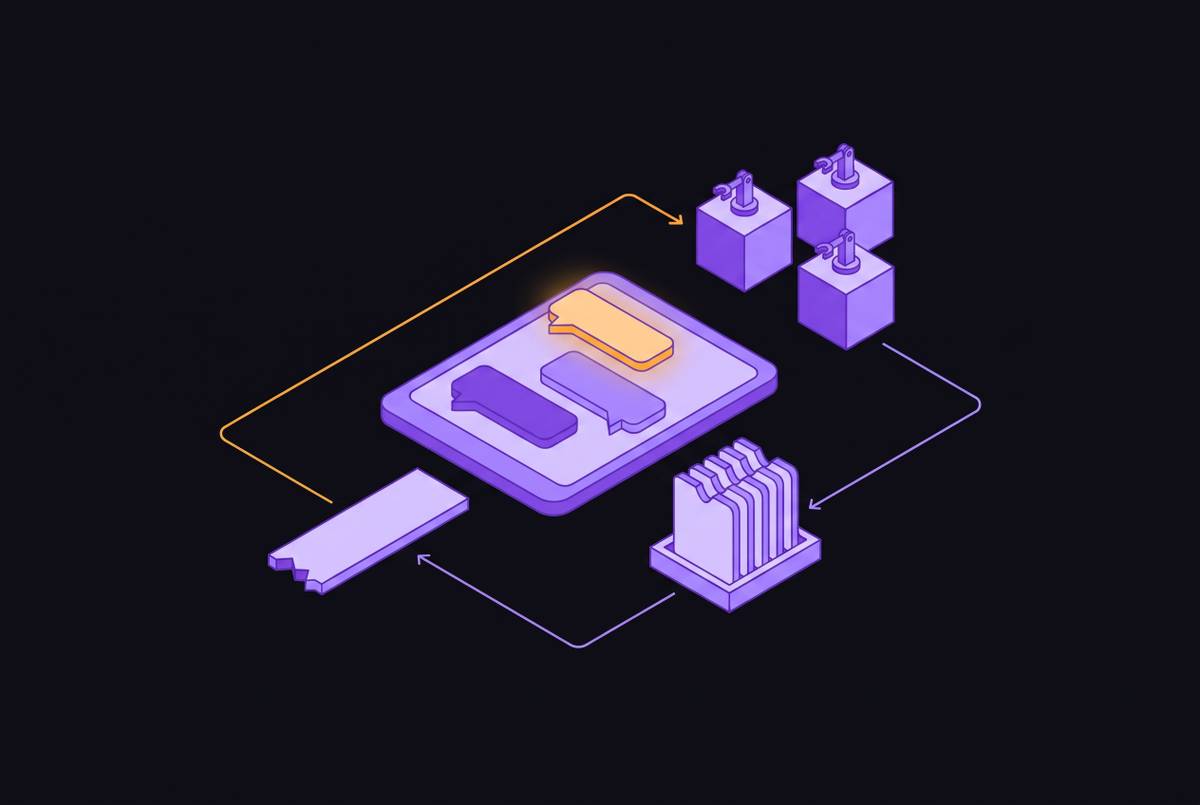
A multi-harness cloud platform provides the third path by separating dispatch from execution. Linear, GitHub, GitLab, or Slack supplies the task, while the selected harness runs in an isolated VM pre-loaded with dependencies and tooling. For teams asking how engineers can trigger Claude Code or Codex from Slack and receive a pull request automatically, this is the harness-independent route. The platform returns the pull request to the originating repository and attributes runs to their source, harness, model, and credential. It requires connecting the tracker and repository, but unlike the other two paths, it permits switching among Claude Code, Cursor, Codex, and Opencode without rewiring dispatch.
How to write a ticket that an agent can actually execute
A vague ticket can leave an agent exploring with no clear point at which to stop, making off-target changes that add to review debt. Human-oriented tickets often omit details that an engineer would recover through conversation or familiarity with the codebase. An autonomous session instead needs enough information to plan, execute, and verify within its available context. Ticket quality is therefore part of the execution contract.
For teams adopting this workflow, the practical remedy is to state a testable acceptance criterion, identify the files or modules in scope, and define completion through checks the agent can run. Constraints on the approach belong in the same specification, including whether the public API must remain unchanged. The title should have an imperative verb and state the scope and outcome. The supplied pattern is “Add pagination to /api/users — return cursor-based, add test coverage, do not change response shape”. The body then identifies acceptance criteria, in-scope and out-of-scope files, and a verifiable “done when” condition.
Adding structure is real work, but its benefits are not exclusive to agents. A bounded specification also gives human engineers a clearer target, and a lightweight pre-processing step can generate the agent template from an existing ticket. Repeated conventions belong outside the individual ticket. AGENTS.md and CLAUDE.md let teams encode codebase conventions, security constraints, and review standards once, then load them at session start. These files serve as onboarding documentation for the agent, freeing each ticket to describe the change without restating the team’s operating rules.
Context, memory, and what happens on tasks that take longer than one session
Context degrades as work extends across sessions. Cursor’s research describes frontier models losing the big picture, forgetting how far they have got, or stopping before the work is done. The operational response is persistent shared state. A later session needs access to accumulated findings alongside the original request.
Projects addresses this through shared context files that accumulate research notes, artifacts, learned preferences, and codebase discoveries across sessions. A coordinator agent can delegate work to parallel subagents, while Slack channels, pull requests, and schedules can trigger activity without a fresh prompt each time. This changes the unit of delegation from an isolated conversation to a project with retained context. For engineering teams, the distinction separates bounded tickets from work that depends on discoveries made during earlier runs.
Context management also affects the cost of execution. Cursor improved its harness by moving those tools into dynamic context, which cut total tokens by 46.9% across sessions that called an MCP tool while keeping quality the same. Cursor, Claude Code, and Codex support MCP as a connector layer to external systems, including issue trackers, test runners, and deployment pipelines. Mature use means loading tools on demand, enforcing least privilege, and limiting connections to the servers needed. Teams should plan to use ephemeral sessions for bounded tickets, persistent coordinators for work that spans sessions, and harness-independent dispatch so they can switch models without rebuilding the context infrastructure. Longer-running agents with persistent context also have a larger blast radius, making execution boundaries and review capacity more consequential.
Security and review obligations that grow with delegation volume
The strongest objection to ticket-to-PR delegation is that it assumes human review will catch what the agent introduces. Review queues can expand faster than reviewer capacity, while agentic systems are already a documented breach vector. A functioning trigger and a returned pull request do not, by themselves, establish a safe workflow. The review gate must scale with delegation.
Environment isolation is the first line of defense. Firecracker microVMs and gVisor containers establish boundaries that shared environments do not, limiting the agent’s access to the host infrastructure. A protected execution environment does not establish that a proposed change meets the project’s security or correctness requirements. Teams still need to check those requirements after the agent runs and before merge.
To support that process, teams should encode review standards in rule files so agents self-check before opening pull requests. PR summaries and explanations of uncertainty can reduce the effort required to understand a proposed change. This preparation helps people judge the work while leaving that judgment in their hands. It also makes review debt a tooling and process problem that teams can address, rather than an inevitable reason to reject delegation.
Attribution provides the next layer of control. Recording the source, harness, model, and credential for each run lets teams compare quality across the pipeline and see how agent-produced pull requests differ. That comparison helps when teams hand off more work and what reviewers see in individual reviews no longer shows how the whole system is doing. Instrumented runs make quality regressions visible at the pipeline level before they accumulate into review debt.
Measuring whether ticket-to-PR delegation is actually working
Deployment frequency, lead time for changes, change failure rate, and time to restore service show how well teams deliver changes, beyond how much output agents generate. Agents can compress lead time when review latency falls and increase deployment frequency when test authoring stops being a bottleneck. But if the change failure rate rises, teams still need proof that productivity has improved, however many pull requests appear.
LinearB’s 2026 AI benchmarks found that even top-performing organizations have fewer than 5% of pull requests coming from fully autonomous agents. Most AI-assisted pull requests still have a human involved at some point. That limits what teams should infer from broad claims about AI adoption. Weekly agent use and fully autonomous ticket-to-PR delivery describe different levels of workflow integration.
Teams should also plan for a J-curve in measured productivity. Early adoption can slow delivery while engineers learn to write executable tickets, tune rule files, and calibrate review standards. Measuring from day one helps identify when performance improves and which changes can be repeated. Full attribution strengthens that analysis by connecting each merged pull request to its agent, harness, model, and source. It supports comparisons of quality outcomes that self-reported usage cannot provide.
Those comparisons need to survive changes in tooling. The JetBrains survey shows Claude Code and Codex adoption rising sharply while Cursor’s share declined. When dispatch and attribution are tied to one harness, following a different model also requires rewiring measurement. Harness-independent attribution instead preserves the basis for comparing delivery outcomes across execution choices. Paths should be compared on how quickly they produce acceptable changes, with delivery outcomes taking precedence over harness activity.
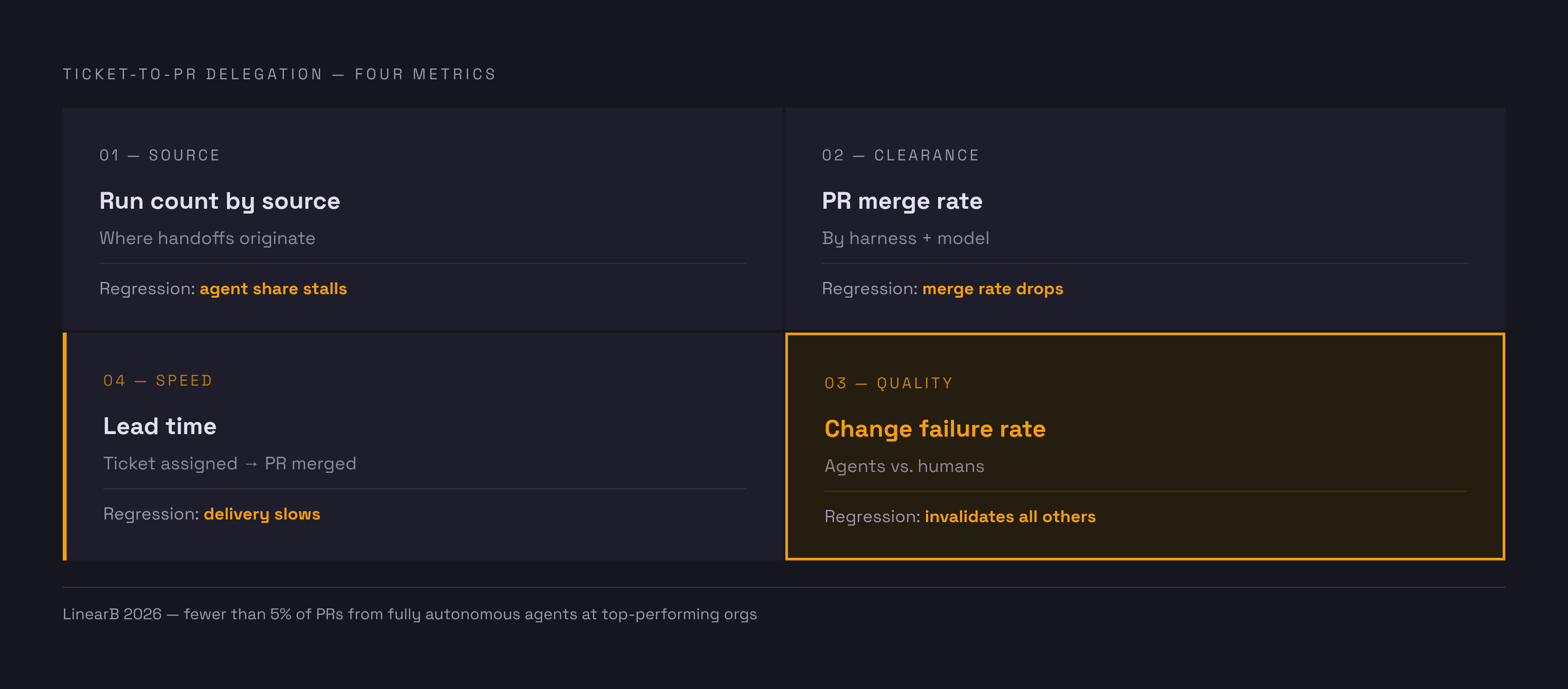
A dashboard should show agent run count by source, PR merge rate by harness and model, change failure rate for pull requests from agents versus those from humans, and lead time from ticket assignment to merged PR. Each reveals a different part of the loop. Run count shows where teams hand off work, while merge rate shows how much of that work makes it through review. Change failure rate tests the quality of shipped work, and assignment-to-merge lead time exposes whether the handoff actually shortens delivery.