The Slack Command That Hands Coding Work to a Managed VM and Disappears From Your To-Do List
Slack and Linear agents turn requests into reviewable pull requests.
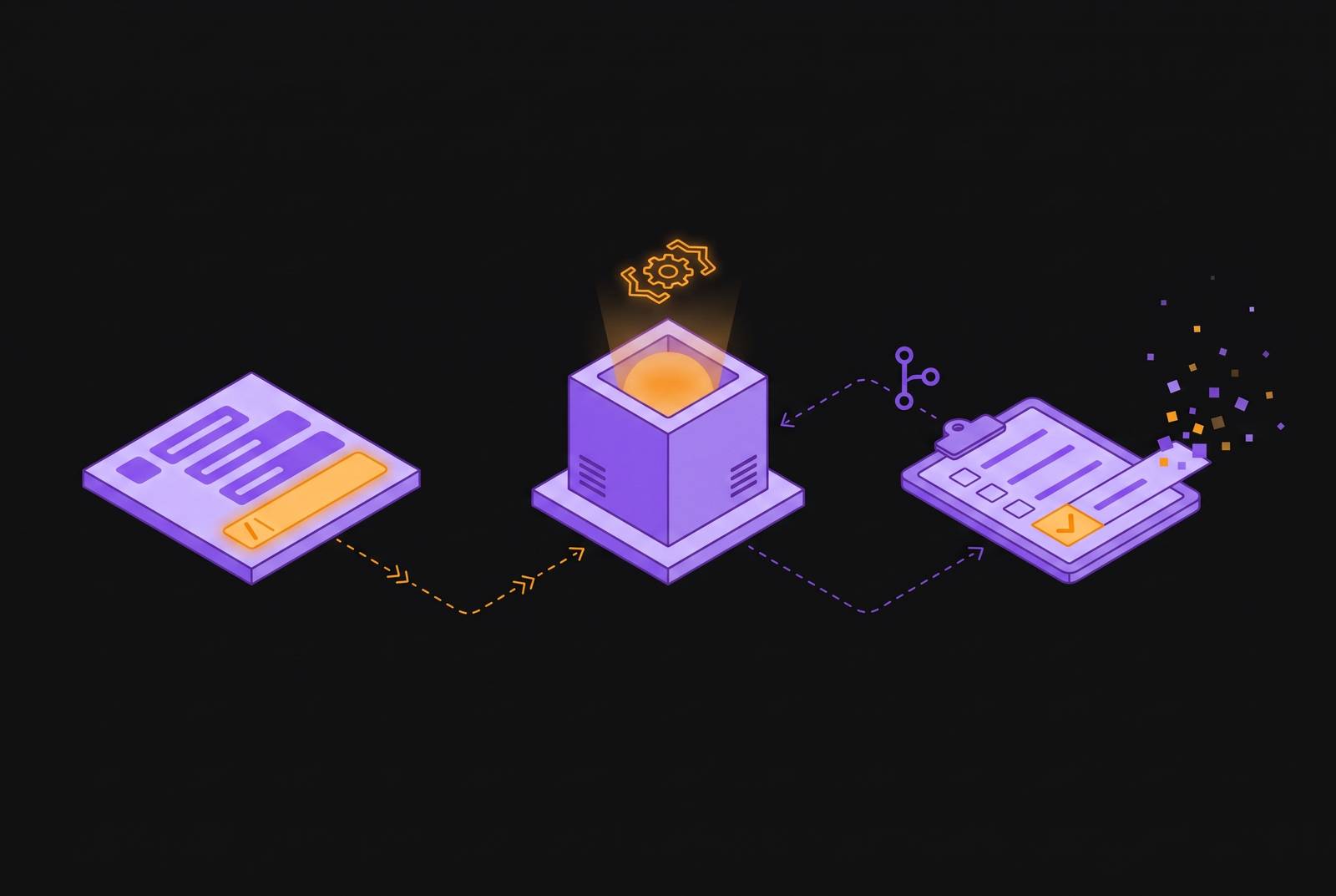
Slack and Linear integrations for autonomous coding agents link what engineers discuss to the work agents run, going beyond another chat interface. Slack can start cloud coding sessions through Claude Code, Cursor, or Codex, while Linear-based agents such as Coinbase’s Forge use what they know about a task to make code changes. The key is the managed, isolated execution environment, where a request becomes a pull request that someone can review without tying up a developer’s machine.
Why engineering context stranded in Slack never made it to the codebase before
Engineering conversations and code changes have taken place in separate environments. A Slack thread might have the bug report, the constraints a fix must meet, and the discussion of what it should do. Acting on it still required someone to open a terminal, reread the conversation, and enter the problem into a coding tool. That transfer depended on a person being available. It also introduced a point where context could be lost, because the working description was reconstructed from the conversation.
The separation was especially visible in reactive work. A weekend bug report or a sprint-day “can someone take this?” could reach someone who understood the problem but was not at a terminal. Coding tools were not the missing component. The missing connection was between the place where the request became intelligible and the environment capable of acting on it. A Slack-native trigger closes that connection by making the conversation itself the starting point for execution.
How does a team trigger Claude Code directly from a Slack thread?
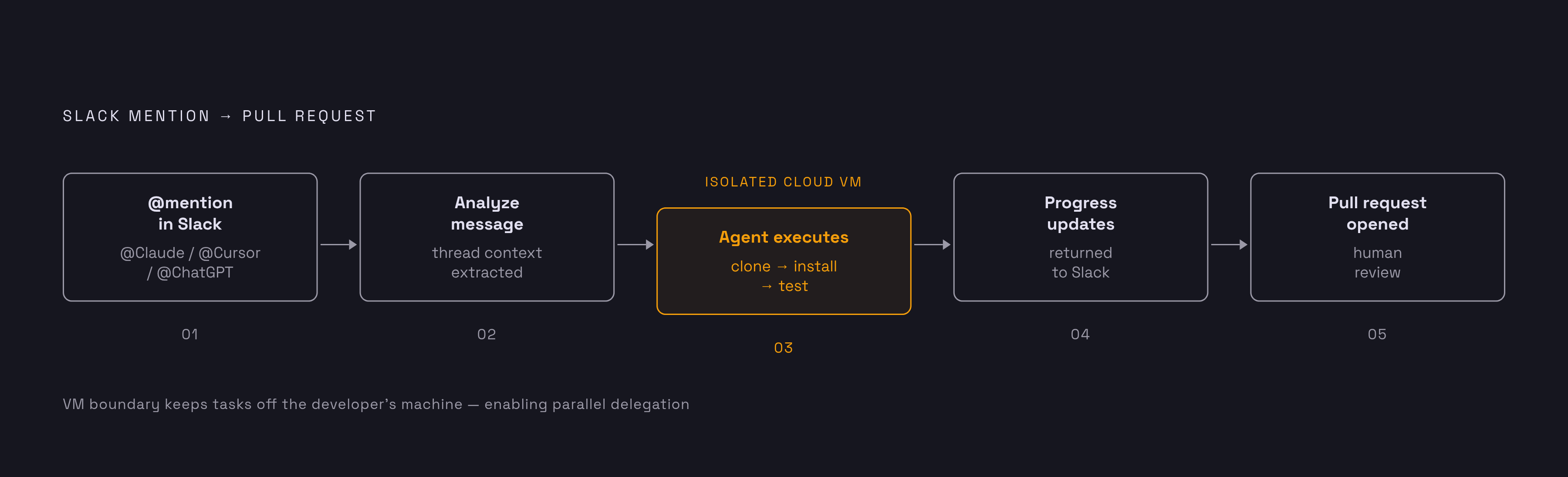
Anthropic’s December 2025 preview described a coding workflow. When someone mentions @Claude, the system analyzes the message and, if it constitutes a coding task, creates a Claude Code session and pulls context from the thread or channel messages. Execution takes place in Anthropic’s cloud. Progress returns to Slack, while the transcript and code changes sync to claude.ai/code, where the user can open a pull request.
The account boundary is part of that mechanism. In the preview model, the session runs under the mentioning user’s Claude account, connected GitHub repositories, and plan. The thread supplies context, but the connected account determines the scope of the run.
The team installs its Slack app, links accounts, connects a repository provider with a default repository, and enables usage-based pricing. An @Cursor mention in a channel or direct message starts a run on Cursor’s infrastructure, which posts status updates and links the finished pull request. Codex uses @ChatGPT with Cloud delegation enabled to hand repository work to a Codex Cloud task. The output paths are not identical, but each sends work outside the developer’s machine and returns updates and results to Slack.
The organizational shift that happens when @Claude is a shared team identity, not a personal account
Claude Tag’s August 2026 change moves the integration from per-user sessions toward a shared, admin-scoped identity. Before that change, delegation depended on an individual’s connected account and repository permissions. With a shared identity, teammates in a shared channel can trigger work without each maintaining a separate account connection.
Admins control which channels have agent access. A product manager, support lead, or on-call engineer can thus start a coding task even if someone else set up the repository connection. This makes Slack a team-level delegation surface, while preserving a place for the organization to decide where delegation is allowed.
Coinbase built Forge on Linear’s Agent SDK to operate across Slack, GitHub, and Linear, using context already present in each. Linear’s account describes the company treating Linear as the place where agents get their bearings before starting a task. Slack is where the conversation starts, Linear has the task context, and GitHub is where code review takes place.
Why the work needs to execute in an isolated VM, not on a laptop or a shared server
A developer’s laptop is a shared, stateful working environment. It contains credentials, open files, and running processes that exist for reasons unrelated to the delegated task. An agent operating there inherits that surrounding state, and its activity is not inherently visible to the rest of the team. Delegation therefore competes with the developer’s own work. A command sent from Slack has not truly separated the task from the person if execution still depends on that person’s machine.
An isolated cloud VM provides a different boundary. Within it, an agent can clone a repository, install dependencies, run tests, and prepare a pull request without altering the developer’s local environment. A runaway process, poisoned dependency, or misconfigured test suite remains separated from local work and other isolated workstreams.
The same boundary is necessary when several agents work concurrently. A shared server session can let agents change the same files or interfere with the same test suite at team scale. Cursor’s August 19, 2026 update placed subagents in separate isolated VMs so they could work in parallel without colliding. The VM is therefore more than hosting. It is the unit that separates one agent’s execution from another’s, making parallel delegation practical without turning every task into shared mutable state.
How event-driven triggers extend the same loop to work no one is watching
A Sentry alert reached Slack at 3 AM without anyone prompting the agent. The agent traced the root cause, mapped dependencies, confirmed failures and an API returning HTTP 500, wrote the fix and missing tests, and opened a reviewed pull request in roughly nine minutes. An event started the work. This is the clearest expression of the delegation model, because no developer first had to translate the alert into a coding session.
Exa uses this pattern to route Sentry issues through Slack and the Sentry MCP server to coding agents. Those agents open pull requests for people to review. The workflow stays focused on changing code to fix the problem, with automated alert summaries treated as a separate step from solving it.
Cursor’s event subscriptions extend the same principle to pull request events, Slack threads, and cron schedules. A merged pull request or scheduled run can start work without a new command from a person. Scheduled Claude Code agents also run on Anthropic’s cloud infrastructure even when the developer’s machine is off, and use a git repository as a shared store for work done locally and in the cloud. When an alert produces a proposed fix this way, the implementation task can bypass a person’s to-do list, although the resulting review still requires attention.
What the PR-as-output model means for the human on the other end
The pull request is the boundary between execution and acceptance. It gives the agent a defined output without granting it the authority to deploy that output. The human receives a proposed change rather than a report that work has somehow been completed. That boundary is deliberate. It preserves a decision point after the agent has performed the development work and before the change becomes part of the codebase.
Ramp’s Inspect demonstrates this division of responsibility. Built on Linear’s Agent API, it connects specifications, customer feedback, and code, and writes more than most of Ramp’s merged pull requests. Humans review and merge those changes. Forge follows the same structural pattern, producing pull requests for engineers to review across its Slack, GitHub, and Linear workflow. Neither model makes initiating a task equivalent to approving its result.
The reviewable artifact also provides a basis for audit. The diff, test run, commit message, and agent reasoning are visible before anyone merges, so evaluation can focus on the actual proposed change. That is a more concrete standard than general confidence in an agent. For engineering leads, the practical question shifts from whether the agent is trustworthy in the abstract to whether this pull request is mergeable. The review gate is part of the design for autonomous execution.
Where the bottleneck moves once agents are shipping more PRs than humans can review
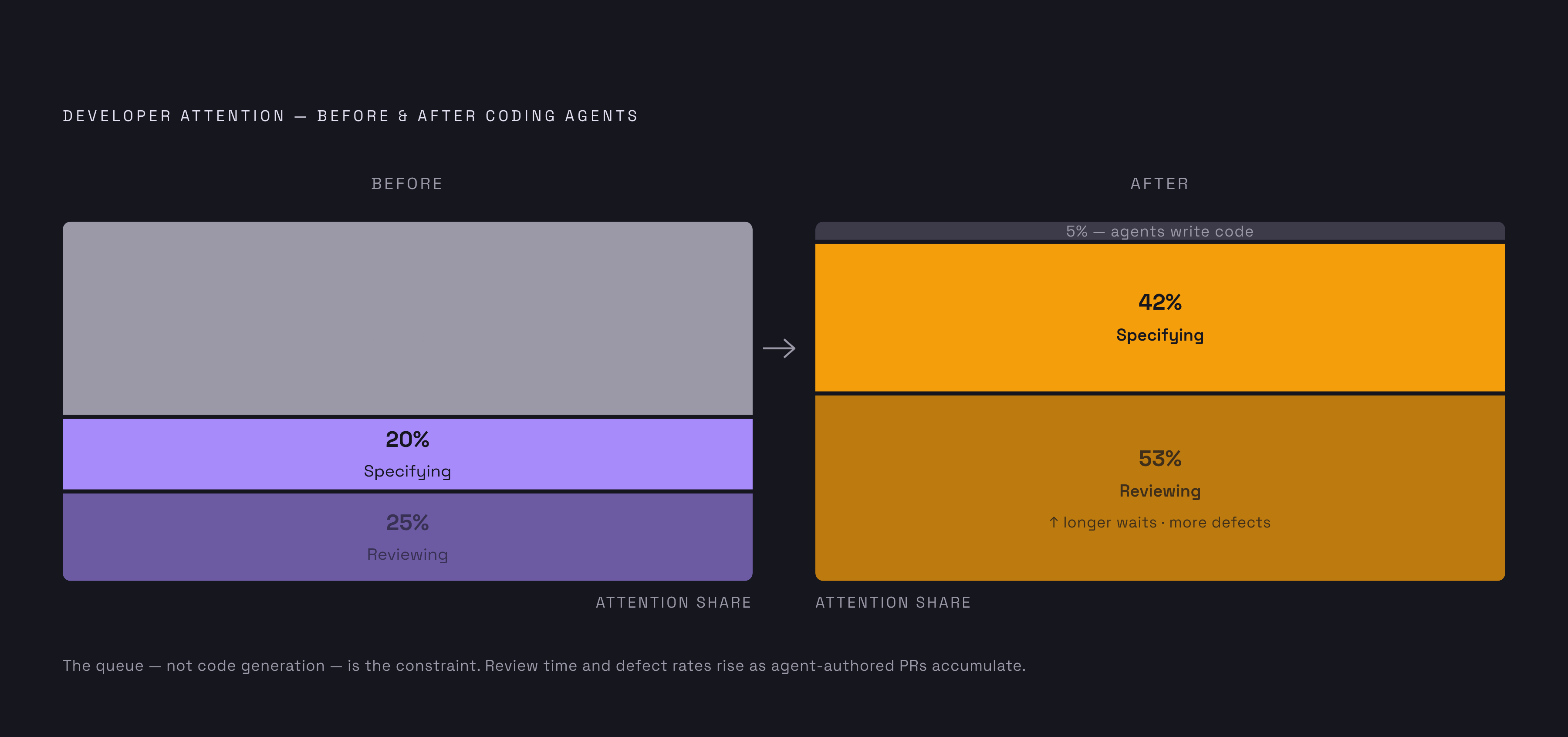
Agents can produce pull requests faster than humans can review them. If teams cannot review more work, more code gets written while the amount of finished work stalls. Teams using Codex CLI and Claude Code report more pull requests together with longer review times, and AI-generated pull requests tend to wait longer for a reviewer than human-authored ones. The queue becomes the constraint.
Leonardo Stern at Agoda saw measurable gains in how much each developer produced but surprisingly small gains in how fast projects moved. His observation places the constraint in specification and verification. Unclear tasks and unreviewed results become more visible as limits on progress once generating code is no longer the slowest stage.
The oversight budget also changes as agents take on more implementation. Human attention shifts from writing code to evaluating it, a task that is harder to parallelize than coding itself. Teams that use coding agents heavily have seen far more defects per developer, which suggests that how well people review code limits progress along with how many reviews they do. A faster review under pressure from a longer queue may not be a better one. The Slack-to-PR loop expands coding throughput, but durable gains depend on specification and verification keeping pace with that expansion.
How teams running agents at scale govern credentials, parallelism, and the review queue
Teams getting durable value from these workflows treat the execution environment and governance model as the product. The harness is only one component. Claude Code, Cursor, Codex, and OpenCode all reach Slack, so the workflow should permit a change of harness without requiring the team to rebuild its delegation model. Teams can compare tools better by looking at trigger support, task isolation, credential scope, and pull request output than by looking at the mention command alone. The persistent layer is the system that controls how work begins, where it runs, and who accepts it.
Teams expanding parallel execution need isolated VMs per task. Teams also need to govern repository access and credentials across the platform instead of setting them up separately for each agent. Claude Tag’s channel-scoped administration is an early form of that control. Enterprise platforms extend it with SCIM, audit logs, RBAC, and customer-managed encryption keys. These controls address different parts of organizational access and accountability alongside the execution boundary.
Teams requiring their own infrastructure have a self-hosted option. Cursor’s self-hosted Cloud Agents reached general availability in March 2026 with support for Kubernetes and APIs for fleet management, and were already running at Brex, Notion, and Money Forward. Cursor’s SOC 2 Type II attestation, held as of November 2026, addresses infrastructure security, while prompt injection through a scraped page or a poisoned MCP server that persists a malicious instruction across a session requires agent-level controls. Teams need agent-level controls as well as perimeter controls.
Review needs an equally explicit operating model. Scheduled and event-triggered agents keep making pull requests without waiting for a person to put together a batch of work. Engineering leads who route agent pull requests into a dedicated Slack review channel, with explicit ownership and SLAs, fare better than those who mix them into the general queue. Delegation frees people from having to start the coding session. It does not remove the obligation to decide whether the resulting change belongs in the codebase.