From Zero Agents to a Full Parallel Queue Without a Single Infrastructure Decision
Cloud agent platforms now handle provisioning and isolation, so parallel queues scale.
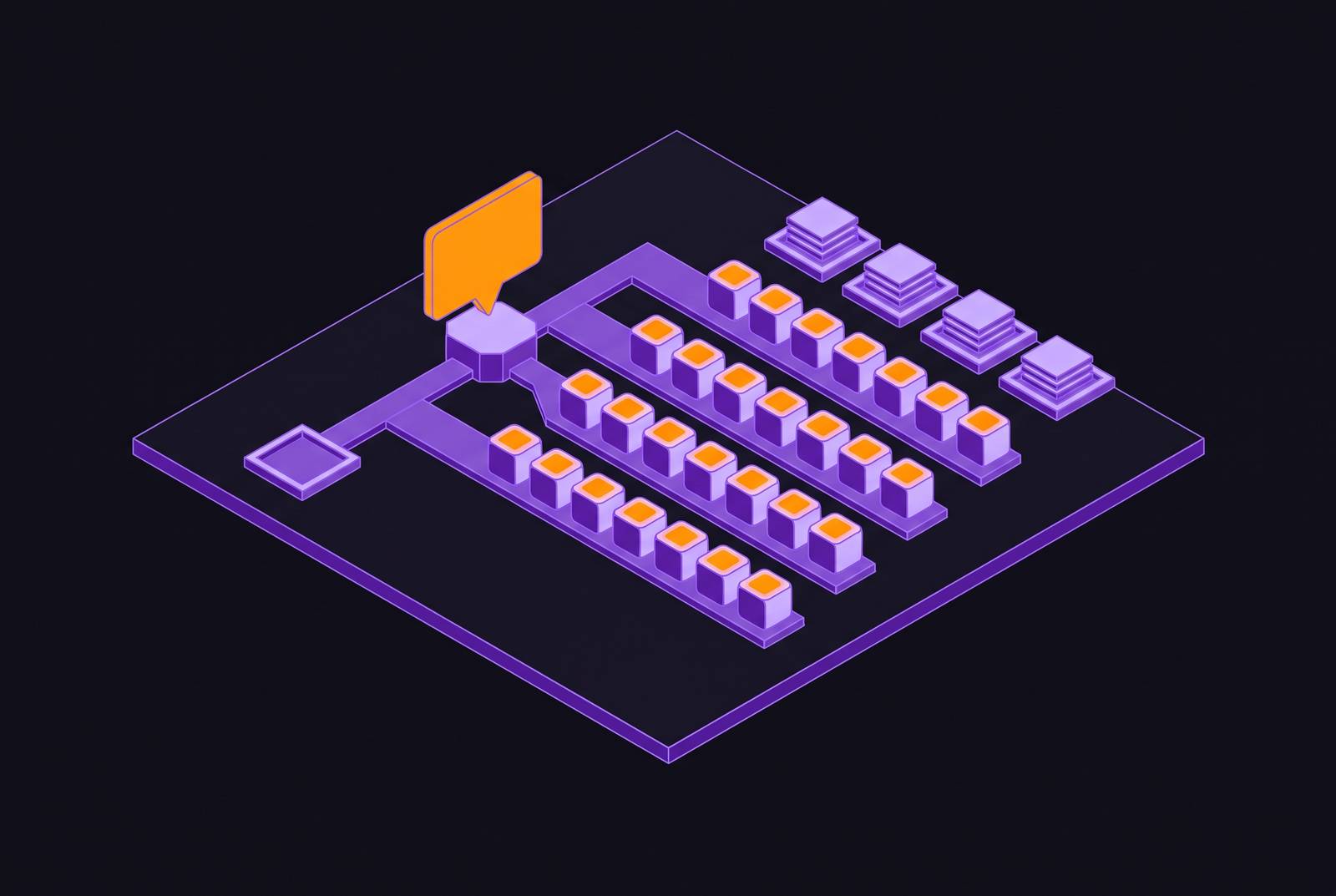
With a multi-harness cloud coding agent platform, teams can run agents in parallel and leave provisioning, isolation, and orchestration to the environment. The shift from a first agent to a full queue no longer requires teams to build infrastructure for each worker. It requires an environment that keeps sessions separate, connects agents to work, and leaves the choice of harness open.
Why teams stall between their first agent and running more than one
A successful first task proves that an agent can do useful work. It does not establish that a team can run several agents safely on the same repository. Historically, each additional agent needed its own VM, checkout, credentials, and separation from other sessions. Platform or DevOps teams had to supply those pieces before the additional worker could produce a pull request. The second agent became an infrastructure project.
That burden encouraged sequential work even when tasks could be split. Adoption stalled at one agent, one developer, and one task at a time, leaving the potential throughput gain unrealized. Git worktrees addressed checkout collisions by giving agents separate working trees, but they did not supply separate compute. Running those environments locally still tied up developer machines and widened the security surface. This infrastructure burden is what cloud environments now absorb wholesale.
What cloud environments now absorb at the first agent step
For a first cloud session, the vendor supplies the VM, isolation, toolchain setup, and teardown as part of the product. Teams no longer choose a machine type, install the toolchain by hand, manage SSH keys, or clean up the machine afterward. The session also outlives the developer’s local connection. Closing a browser tab or shutting a laptop lid does not stop the agent.
Claude Code exposes that model through claude.ai/code, the Claude mobile app, the desktop app, and claude --cloud in the terminal. A running session can return to a local terminal through claude --teleport. Teams set up environment variables, network access, and a setup script once, with no need to do it again for each task. The installed files are cached for later sessions. Configuration remains, but per-session provisioning disappears.
Codex cloud follows the same pattern in an OpenAI-managed container, with entry points on the web, desktop, and mobile, plus experimental CLI support. It preserves files, including uncommitted changes, so a task can reopen from another device, with recovery available for up to seven days after the last turn. Northflank Cloud Harnesses run agents inside a customer’s AWS, GCP, Azure, Oracle, or CoreWeave account, with a microVM per agent and per-vCPU-hour billing. The distinction is where execution happens.
How isolation at the environment level is what makes parallel work safe
Parallel work needs separate execution environments as well as separate prompts. Each agent needs its own branch and working state so that edits in one task do not change another task still in progress. Git worktrees provide that separation for checkouts. Cloud environments extend it to the filesystem, process space, and compute resources. One runaway session cannot use up the memory set aside for another session.
That boundary also separates credentials between sessions. Claude Code uses isolated, vendor-managed VMs, while Codex provides configurable network settings for each environment. Its agent phase is offline by default unless access is turned on, which limits its chances to fetch new dependencies as it runs. Cursor cloud agents similarly work on a separate branch in an isolated VM and push changes for a pull request. With self-hosted machines, Cursor runs the agent loop, but file edits and terminal commands run on infrastructure the team controls.
Developers can dispatch independent tasks without supervising how their working files and processes interact. Startup latency is the counterweight. A fresh VM takes time to provision, but cached setup files, as used by Claude Code cloud environments, allow subsequent sessions on the same environment to start near-instantly.
What a full parallel queue looks like in practice, and what makes it work
A full queue is a workflow in which multiple agents tackle distinct tasks and return pull requests to a shared review process. A feature branch, a test suite update, and a dependency audit can proceed at the same time. Each worker has its own worktree or cloud VM. Developers send work to agents and review what comes back, without having to stay with each coding session. The queue becomes the unit of coordination.
For the three independent tasks, elapsed execution time is determined by the longest task. More workers do not automatically create more independent work. The work in a queue still needs to be split into tasks that can run on their own.
Isolation resolves interference during execution, but it does not prove that every proposed change belongs in the codebase. Changes on separate branches may still need to be reviewed together.
How do engineers trigger Claude Code or Codex from Slack and get back a pull request?
A Slack-to-pull-request workflow needs more than a message forwarded to an agent. It needs an integration that connects the request to the repository and the context behind the work. Linear Agent can write code using Claude Code and Codex, and integrations built on Linear link the work in Slack, GitHub, and issue records. The exact entry point depends on the integration. Support for a harness alone does not establish a complete Slack-to-pull-request path.
Ramp built Inspect on Linear’s API to link specifications, customer feedback, and code. Inspect now writes three of every four pull requests that Ramp merges. Coinbase built Forge on Linear’s Agent SDK to work across Slack, GitHub, and Linear using the context already present in those systems. Coinbase described Linear as “the place where agents go to get their bearings before starting a task.”
Those examples address the next constraint after provisioning disappears. A queue cannot run efficiently if every task requires a developer to reconstruct its history in a fresh prompt. Integrations instead bring together the context in tickets, linked customer requests, and monitoring data. Event triggers can also start work, but what they can do depends on the product. ChatGPT scheduled tasks on eligible plans can respond to supported Gmail, Slack, and GitHub events, yet those web and mobile features are distinct from Codex cloud and cannot target a repository environment.
How the queue closes the loop: agents responding to CI, review comments, and production alerts
Initial dispatch is only the start of a task. A pull request may fail CI, get review comments, or need another look when new evidence comes from production. Claude Code cloud sessions can watch a pull request and respond to CI failures and review comments without a developer manually triggering the next step. The environment retains a route back into the work. That changes the queue from a one-shot batch into a continuing process.
Other integrations retain an explicit human trigger. Codex’s GitHub app can read CI results and respond to @codex mentions in pull request threads, including threads on pull requests it opened. GitLab support in beta extends that pattern to merge requests. This is not equivalent to automatically acting on every review comment. The trigger determines how much coordination remains with the developer.
Review itself can also draw on more than the diff. Multi-agent review systems assign specialized reviewers to different quality dimensions, while code graph analysis and tool integrations bring in context from Sentry and an observability platform. Custom review agents can use GitHub check runs that block merges to enforce rules written in plain-English. A check can examine recent errors for a modified file, verify a feature flag, and post a summary to Slack without glue scripts.
Production triage takes the same loop beyond code review. An illustrative pattern is a Slack notification when an agent opens a remediation pull request, followed by an hourly routine that asks which reviewer has the most relevant commit history. Routing becomes part of the automated work. The objective is not merely to generate changes, but to return each change to the person or signal needed for its next step.
What enterprise teams need before the queue can run at scale
For a larger organization, automatic provisioning is insufficient without governance. A platform that removes VM management but leaves access policy, evidence collection, and contractual safeguards unresolved has not removed the principal deployment barrier. The environment must be ready for enterprise use. Otherwise, the queue scales execution faster than the organization can account for it.
The required controls include SOC 2 Type II certification, SAML SSO, SCIM provisioning, and administrative controls for seats and policy enforcement. Audit logs must record what each agent accessed so that a security review does not depend on manual reconstruction. Clear training-data policies must provide an option to exclude customer code. Enterprise support SLAs and contractual commitments make those requirements more than product settings. Together, they define the terms under which unattended execution is acceptable.
VPC and self-hosted options let organizations run agents on infrastructure they control, while isolated Linux VMs keep each agent session separate. These controls address different questions from whether an agent can complete a coding task. They establish who may start work, what the worker may access, and what evidence remains available for review. The cloud model removes infrastructure management from the task path only when governance is supplied at the same level as provisioning.
The one decision that remains: which harness the team runs
Once the environment handles execution and governance, the remaining choice is which coding agent to run. That choice should remain reversible. Claude Code on the web, Codex cloud, Cursor cloud agents, Copilot in the cloud, and Devin offer different execution models, entry points, and strengths. No single harness is the right answer for every team or task. A multi-harness environment preserves the ability to choose without rebuilding the surrounding workflow.
Teams need to weigh both the code each agent writes and how it fits the queue. Relevant criteria include how tasks start, where commands execute, how follow-up work is triggered, and whether producing a pull request is automatic or requested. These differences affect routing and review. They belong in harness selection rather than being hidden behind a generic claim of cloud execution.
The risk of permanent commitment is concrete. Jules winding down illustrates why a workflow tied to one harness can inherit that harness’s lifecycle, as well as its pricing changes and capability gaps. When agents are interchangeable components, teams can swap them through the environment’s built-in support without moving their infrastructure. The team’s decision becomes which agents to run this week. A stable environment with interchangeable agents is the structural advantage of the multi-harness cloud model.