The Slack-to-Pull-Request Handoff Protocol Engineers Actually Want to Receive
How to structure agent handoffs from Slack so reviewers can actually verify the work.
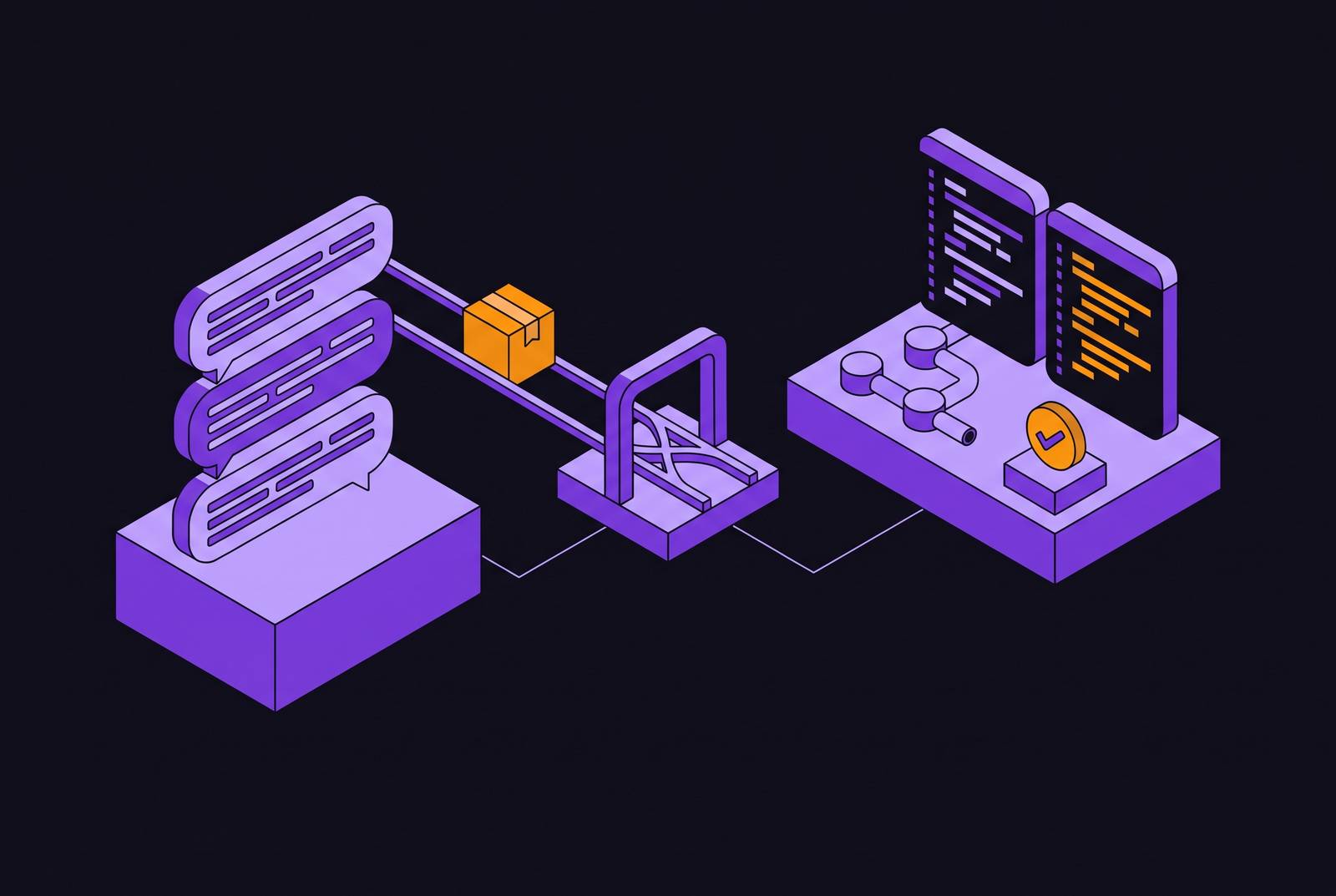
To run Claude Code in the cloud, delegate a bounded task to an isolated environment that can install dependencies, execute tests, preserve state, and return a pull request through existing review controls. The Slack-to-pull-request handoff protocol engineers actually want to receive connects that environment to a precise task specification and evidence a reviewer can inspect.
Why the Slack-to-PR handoff is a new kind of engineering interface, not just automation
The 2026 engineering stack has three distinct layers. The IDE supports real-time collaboration, the CLI supports local execution, and cloud agents support asynchronous delegation. The Slack-to-PR handoff expresses that third layer by turning a conversation into implementation work that returns for review. It is now a product surface. That shift gives engineers a reason to judge the whole handoff instead of just accepting what an automated connection gives them.
Anthropic’s 2026 Agentic Coding Trends Report describes agents handling entire implementation workflows end-to-end. GitHub Copilot in Slack entered public preview on August 21, 2026, bringing planning, investigation, and coding delegation into conversations. Slack Code API became generally available on October 28, 2026, so developers could move large coding tasks into shared channels set up for each task. Teammates can inspect progress and add context there. These features make the interaction between a request, an agent’s work, and human intervention part of the product itself.
As a result, opening a PR is no longer a sufficient measure of success. A handoff can complete every automated step and still leave an engineer unable to establish whether the change achieves the stated outcome. The work then shifts to the reviewer. The relevant standard is whether the interface preserves intent, exposes verification, and makes uncertainty visible from the original conversation through to the proposed change.
What tasks belong in a Slack-to-PR workflow and what don't
Bounded, testable, reviewable tasks belong in this workflow because their results can be inspected against a clear expectation. Adding tests, upgrading dependencies, fixing lint errors, mechanical refactors, synchronizing documentation, and resolving small bugs share that property. Their scope gives the agent a defined target. More importantly, it gives the reviewer a basis for accepting or rejecting the output without first reconstructing what the request meant.
Kilo for Slack reads the thread, accesses connected GitHub repositories, creates a branch, and submits a PR. Its design rests on a practical premise. A thread may already contain the context needed to fix a bug or implement a feature. However, the presence of a discussion does not establish that the task is ready for delegation. The useful distinction is whether that discussion resolves the intended behavior and supplies enough information to verify it.
Tasks fall outside this scope when the failure cannot be reproduced in an isolated environment because production data, real configuration, or timing is unavailable. Requirements that are unclear cause a different problem that is just as serious. An agent can turn its interpretation into an implementation, then write tests that confirm that same interpretation, demonstrating internal consistency. The practical filter is therefore whether the problem and its acceptance condition can be established before implementation, rather than whether the agent appears capable of editing the relevant code.
What the trigger message needs to contain for the agent to act reliably
The trigger message must function as a task specification. It needs the intended change, the repository and relevant file or area, the acceptance condition, and any constraint on the work. These elements define both permission and success. A constraint might identify an area that must remain untouched or an existing pattern the implementation must follow, while the acceptance condition states what passing looks like independently of the proposed solution.
A weak trigger names a symptom but omits the expected behavior. Another names a desired change without identifying the repository or narrowing the affected area. A third supplies both but leaves out a constraint.
Slack2PR divides its work into intent classification, requirements gathering, component planning, implementation, testing, and PR creation. Precision in the trigger supports that first classification step. Kilo reads the full thread rather than only a mention, so prior discussion can enrich the specification when it contains settled requirements. Copilot can create a dedicated Slack Code channel to separate task context from the original conversation. The parallel with assigning a GitHub issue to a cloud agent is direct, because a well-formed Slack message imports the issue’s structured task description into chat.
What the isolated environment needs to do between trigger and PR
Cato Networks’ DuneSlide disclosure establishes the security stakes of agent execution. Isolation is a security decision. Giving an autonomous agent unrestricted infrastructure access expands the possible consequences of its actions. Yet a sandbox boundary alone does not settle the question, because the agent’s output can reach components that execute or interpret it outside that boundary.
Security teams should therefore inventory every unsandboxed component reachable from sandbox output. That includes Git hooks and config files, IDE extensions that read project-local interpreter paths, task runners, package managers, and reachable or mounted daemon sockets. Secrets and credentials should remain outside the sandbox, with egress limited to an allowlist. This defines the boundary beyond the execution process itself. It also separates the access needed to complete a task from unrestricted access to the surrounding infrastructure.
Within that boundary, the agent needs a cloned repository, installed dependencies, and the ability to install packages, run services, and execute tests. State must persist across the run. Slack2PR reuses the same environment across planning, implementation, testing, and delivery. Cursor Builds, shipped August 13, 2026, boots agents into a pre-configured environment, with failed builds not activating while someone debugs offline.
For teams evaluating how to run agentic coding tasks in the cloud without managing their own infrastructure, these are concrete environment requirements. Verification is still a problem when execution is managed. Locked-down sandboxes often cannot reach staging environments, real databases, or preview URLs, so they cannot reach the production failures there. When the agent cannot reproduce the failure, its output may address a plausible cause rather than an established one. That limitation must remain visible through delivery.
How the agent should structure its work between trigger and PR to produce something reviewable
Explicit stages make the agent’s reasoning and work inspectable without requiring a reviewer to reconstruct the entire run. Slack2PR provides a concrete model by classifying intent, gathering requirements, planning components, implementing each component, writing and running tests, and then opening the PR. Each stage has a distinct purpose. Requirements say what the change must do, planning sets out how to do it, and verification tests whether the change meets those requirements.
Copilot shows plans and diffs in the code channel before the PR opens. Teammates can inspect output previews, add context, redirect the approach, or stop the session. This lets teammates correct how the agent has read the request before it finishes the change. A staged workflow need not add review overhead when it exposes decisions that an engineer would otherwise have to recover through a lengthy manual audit.
Claude Code’s experimental agent teams workflow, introduced in v2.1.32 on 2026-02-05, coordinates multiple Claude instances working in parallel on a shared codebase. It uses git-based task claiming and a mailbox messaging system, with isolated agent contexts and a shared coordination layer. Contributions can therefore be attributed to their tasks. Parallel execution does not eliminate the need to explain how each contribution serves the original request.
The test-writing stage provides the strongest check on that connection. Tests should follow the trigger’s acceptance condition. Otherwise, the agent supplies both the theory and the evidence used to endorse it. Attribution also supports review policy. GitHub repository administrators can require additional approval for PRs unattributed to a person, including those opened under the Copilot app identity, with that protection enabled by default in rulesets.
What the PR itself needs to show for engineers to want to merge it
The PR must explain what the agent understood, what it changed, why it chose that approach, what it verified, and where uncertainty remains. Review capacity is the binding constraint once agents produce more changes than engineers can meaningfully assess. Without adequate evidence, the choices become under-reviewed merges or an expanding queue. A clear description makes it easier to judge whether to accept the change. It still needs proof to back up its claims.
The description should begin with the initiating Slack message or issue and its stated acceptance condition. It should then explain the approach the agent chose and why it chose that approach over others. Verification needs equal precision. The reviewer needs to know which tests ran, whether they passed, and what behavior they cover, rather than receiving an undifferentiated claim that the change was tested.
If the agent could not verify behavior that requires production data or a staging environment, the description should identify that limit and what the reviewer should check manually. Kilo routes its PRs through existing review workflows and approval processes. The human gate remains in place. The quality of the handoff determines how much investigation is needed at that gate.
Analytics that trace each run to its source, harness, model, and credential allow teams to distinguish configurations that produce mergeable work from those that create review debt. LinearB’s 2026 AI benchmarks show that autonomous agent PRs merge at a lower rate than human-only PRs even at top-performing organizations. That gap directs attention to PR quality as a variable teams can control. A PR designed for review turns the handoff into collaboration because the engineer receives both a proposed change and the evidence needed to judge it.
How to integrate the full protocol into the team's existing workflow without adding new overhead
The protocol can grow when the team keeps coordinating work in the tools it already uses. When someone labels a GitHub PR, the agent creates a Linear issue for it. A daily Slack digest then shows open PRs with reviewer status, staleness indicators, and linked issues. The team can see the work that is still pending without having to check another interface.
Claude Code, Codex, Cursor, and Opencode have different strengths, so the protocol should route tasks to the agent that fits the job. The review contract can remain stable. Even when the execution harness changes, the trigger still says what the task is, the environment still keeps execution within bounds, and the PR still shows verification and what is uncertain.
Teams should start the rollout with groups that already ship small PRs, keep their tests strong, and review often. Early users should publish short internal receipts recording the task, prompt shape, diff size, test result, and review outcome. These make successful handoffs concrete enough for others to assess. Retention should be measured through actual agent sessions and merged work. Expansion should follow repeatable examples from the first cohort.
Team-level analytics then provide the feedback needed to refine routing and specifications. Tracking which triggers lead to high-merge-rate PRs, which configurations create review debt, and which tasks require human redirection makes the protocol an operating model. The improvement target is specific. A cloud agent run succeeds when it returns work that an engineer can evaluate within the team’s normal review process, without having to rediscover the task or repeat the investigation.