Why Task Diversity Is the Argument for a Multi-Harness Platform Instead of Standardizing on One Agent
Different coding tasks need different agents, and a shared platform makes that safe.
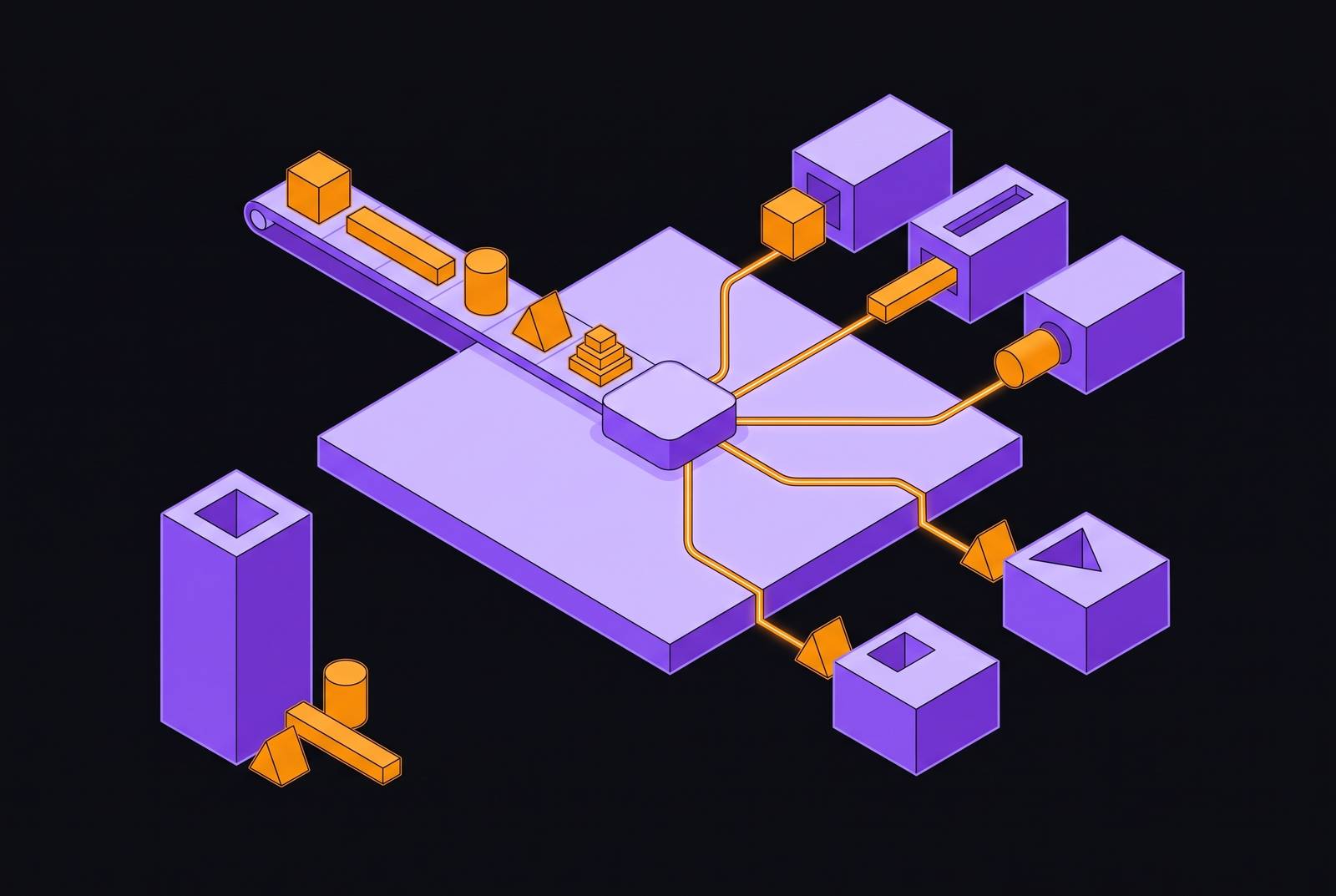
A multi-harness cloud coding agent platform lets teams send different kinds of engineering work to different agents that share the same workflow, security model, and measurement framework. Deep reasoning, rapid editor iteration, and autonomous background work require different execution models, so standardizing on one harness imposes that harness’s limits on work it was not designed to handle best.
Why no single coding agent handles every task type well
The emerging developer pattern pairs Claude Code with architecture and debugging, Cursor with rapid feature development, and Codex with automated workflows and delegation. This is an organic division of labor. Developers switch tools because the next task asks for a different kind of assistance.
Three task categories explain the split. Deep-reasoning work includes architecture and debugging complex systems, where the agent must sustain a line of reasoning across a long task. Rapid interactive iteration includes feature work and inline edits, where assistance sits inside the developer’s editing loop. Autonomous background delegation includes maintenance and CI-triggered automation, where the agent takes on work without needing someone to interact with it throughout. These categories differ in how work starts, proceeds, and returns for review.
The harness determines how the model participates in that process. An agent built for line-by-line suggestions is not the same machine as one built to accept a task description and return a pull request. Both may generate useful code, but they organize the work differently. The team-composition analogy is useful here. A homogeneous team whose members share the same blind spot remains exposed at that point, and assigning varied engineering work to one execution model creates a similar constraint.
How Claude Code, Cursor, Codex, and Opencode differ across the dimensions that actually determine task fit
Four dimensions make the comparison useful, namely execution surface, autonomy model, context window, and task affinity. Execution surface places the work in an editor, terminal, or cloud environment, while autonomy determines how much the developer delegates. Context affects what the agent can keep in mind during a task. Task affinity connects those architectural choices to the work. No single overall ranking captures these differences.
Claude Code uses a delegate-to model in which the developer describes a task and the agent executes it and returns a result. It is best suited to long, complex work that calls for deep reasoning, such as architecture review and difficult debugging. It supports opt-in Git worktrees per agent run through the --worktree flag or a worktree isolation setting for subagents, and has a large context window with auto-compaction. SWE-bench Verified places Claude Code with Claude Opus 4.8 at 88.6%, while CursorBench places Claude Opus 5.5 running through Claude Code at the top of its leaderboard.
Cursor puts assistance inside the editor through Tab completion and inline edits. Its execution model suits developers who spend much of the task actively typing and revising code, particularly during feature development and in-editor refactoring. It also uses Cloud VMs per agent. Terminal comparisons do not capture its central interaction model. Its absence from independent terminal-task benchmarking reflects a capability mismatch with that evaluation surface.
Codex emphasizes cloud delegation, with stricter sandboxing by default and an open-source CLI. Terminal-Bench places Codex with GPT-5.5 in the lead, while its workflow integration makes its background role concrete. The official GitHub Action runs the CLI headlessly using drop-sudo, unprivileged-user, or read-only safety strategies. Sandbox modes are a separate control, including workspace-write and read-only. This architecture suits CI-triggered automation, maintenance that must be done over and over, and autonomous delegation.
Opencode addresses a different constraint, which is control over models and infrastructure. It is open-source under the MIT license and supports 75+ providers plus local models. That flexibility suits teams that need to change underlying models by task type or run on-premise. Model choice becomes another routing variable. The relevant comparison is therefore not just which agent handles a task, but which harness allows the required model and deployment arrangement.
What organic developer behavior reveals about single-harness standardization
Developer communities show the same division in their tool combinations, with Cursor plus Claude Code emerging as the most common pair. The pairing joins interactive editor work with delegated reasoning. It is revealed preference.
If developers already route tasks between harnesses, standardizing on one does not remove the underlying differences between tasks. It either forces work through the chosen tool or pushes switching into workarounds that the organization cannot readily see.
The strongest case for a single harness is administrative. Procurement, security review, and training are easier to manage when the tools share a system than when each tool stands alone. Yet that argument supports platform standardization. A platform that runs multiple harnesses can place governance at the shared layer without requiring every task to use the same execution model. This preserves the organizational purpose of standardization while allowing task fit to guide the agent choice.
That distinction also sets a boundary on the argument. More harnesses are not automatically better. Their value depends on whether they serve different work within a common operating framework, rather than creating separate islands of access, execution, and measurement. The infrastructure must make that framework real.
Why sandboxed, isolated environments are the infrastructure precondition for running multiple harnesses safely
Native isolation differs across the tools. Cursor uses Cloud VMs per agent, Claude Code offers opt-in Git worktrees, and Codex uses a container per task. Those mechanisms do not establish one consistent security boundary. A Git worktree separates working copies, but it is not equivalent to a sandboxed machine.
Each run receives its own VM, pre-loaded with the team’s dependencies and tooling, regardless of the agent inside it. The agent can install packages, run services, drive a browser, and verify its work within that environment. It has a developer-like workspace without sharing unrestricted access. This is what allows multiple harnesses to operate under a common execution policy.
External issues, alerts, and pull request descriptions can contain prompt injection, so a protected workspace must be paired with controls over authority. The safeguards are to treat external content as data rather than instructions, keep production credentials out, redact secrets from logs, and keep human approvals in place. The boundary protects execution, while those controls limit what an agent can be induced to do.
Kubernetes-native approaches apply the same principle at the infrastructure layer. Each agent receives its own Pod and PVC sandbox behind a default-deny NetworkPolicy. The implementation differs from a per-run VM, but the governing idea remains environment isolation at the platform level. Harness diversity then becomes a choice within the boundary.
How can engineers trigger Claude Code or Codex from Slack and get back a pull request?
A multi-harness workflow becomes practical when engineers can initiate work from Slack, Linear, GitHub, or GitLab. The task enters where the team already makes decisions. Routing can then select a harness suited to the work, run it in an isolated environment, and return a pull request for review.
Groundcover’s June 2026 Agent Mode expansion illustrates the depth such integration can reach. Engineers can direct agents to recommend code, open pull requests, and manage tasks inside Slack, Linear, and GitHub. Every action is governed by user-level permissions and tied to a specific authorized user. The identity boundary is explicit. The example demonstrates permission-aware workflow integration, rather than establishing that every integration supports every harness.
Per-user delegated identity supplies that boundary through each engineer’s own OAuth token. A shared service account, by contrast, creates audit gaps between the person requesting work and the authority used to perform it. Workflow convenience cannot substitute for clear attribution. The agent’s access needs to follow the authorized user rather than expand simply because the request originated in a familiar collaboration tool.
In the practical routing model, a Linear issue starts delegated background work in Codex or Claude Code, while interactive editor work belongs in Cursor. The delegated agent runs in an isolated VM and returns a pull request for review. The engineer remains in the existing workflow. The platform infrastructure runs the task, and the kind of task determines which harness gets it.
What the productivity evidence actually says, and why measurement must be harness-aware
The evidence does not show that AI coding assistance improves delivery in every case. DX finds that daily AI users at the companies it tracks have meaningfully higher throughput, based on pull requests that were actually merged. That is an outcome signal rather than a perception measure. It is not, however, direct proof that adding harnesses causes better results. The case for multi-harness routing still needs measurement at the task level.
METR’s randomized trial provides a sobering counterpoint. Experienced open-source developers working on real issues in mature repositories took longer with AI assistance, even though they believed they were faster. Perceived speed and measured speed diverged sharply. The finding makes developer confidence an insufficient measure of productivity and cautions against treating adoption itself as evidence of improvement.
A Harvard study covering more than 700 firms identifies another gap. Developers using AI coding agents wrote substantially more code, but finished issues did not increase by a statistically significant amount. More output did not establish more completed work.
Task-harness mismatch remains an untested possible explanation for flat throughput in those studies. If every task goes through one harness, the overall results cannot show whether a different execution model would have handled some of the queue better. Harness-aware measurement makes that proposition testable. Sprint throughput, cycle time, PR cycle time, and time-to-first-merge describe delivery, while AI Contribution Ratio and agentic commit rate describe adoption depth. AI Contribution Ratio measures the percentage of code output that is AI-assisted.
Amazon CloudWatch Coding Agent Insights, launched July 20, 2026, provides instrumentation across Claude Code, Codex, and GitHub Copilot. It collects OpenTelemetry telemetry, tracks token spend, and correlates adoption with commit and PR velocity while flagging models with the best cost-to-output ratio. Better routing remains a potential benefit to evaluate through those signals.
What full attribution across harnesses, models, and tasks makes visible that single-harness standardization hides
Full attribution links every agent run to the task it came from and the harness, model, and credential it used. That combination lets engineering leaders compare outcomes without collapsing distinct kinds of work into one adoption number. A task from Linear can be compared with similar tasks run through other harnesses. Engineering leaders can compare which harness produces pull requests that merge fastest for that task type. Model and credential attribution retain the execution context needed to interpret the result.
Teams can still measure how task types differ within one tool, but without an internal cross-harness signal, they cannot tell whether another execution model would do better. That is the analytic limitation of fixing the choice in advance. Without runs to compare, it is hard to tell how much of a poor result comes from task difficulty, model behavior, or harness fit.
A multi-harness platform makes routing a policy that can change as evidence accumulates. Delivery measures show which assignments work, while cost and adoption measures help explain the trade-offs. The operational feedback loop’s value comes from using attributed outcomes to refine future assignments rather than preserving an initial tool choice as an organizational constant.
The practical implication for engineering leaders is to start with one harness if necessary, but build on a platform that can add others without changing the workflow, security model, or measurement framework. That preserves a stable foundation while leaving the routing policy open to improvement. Standardization then governs how agents operate. It does not predetermine which agent must handle every kind of engineering work.