Delegating Linear Bug Tickets to Coding Agents
Make bug tickets executable by including behavior, conditions, and relevant code surfaces.
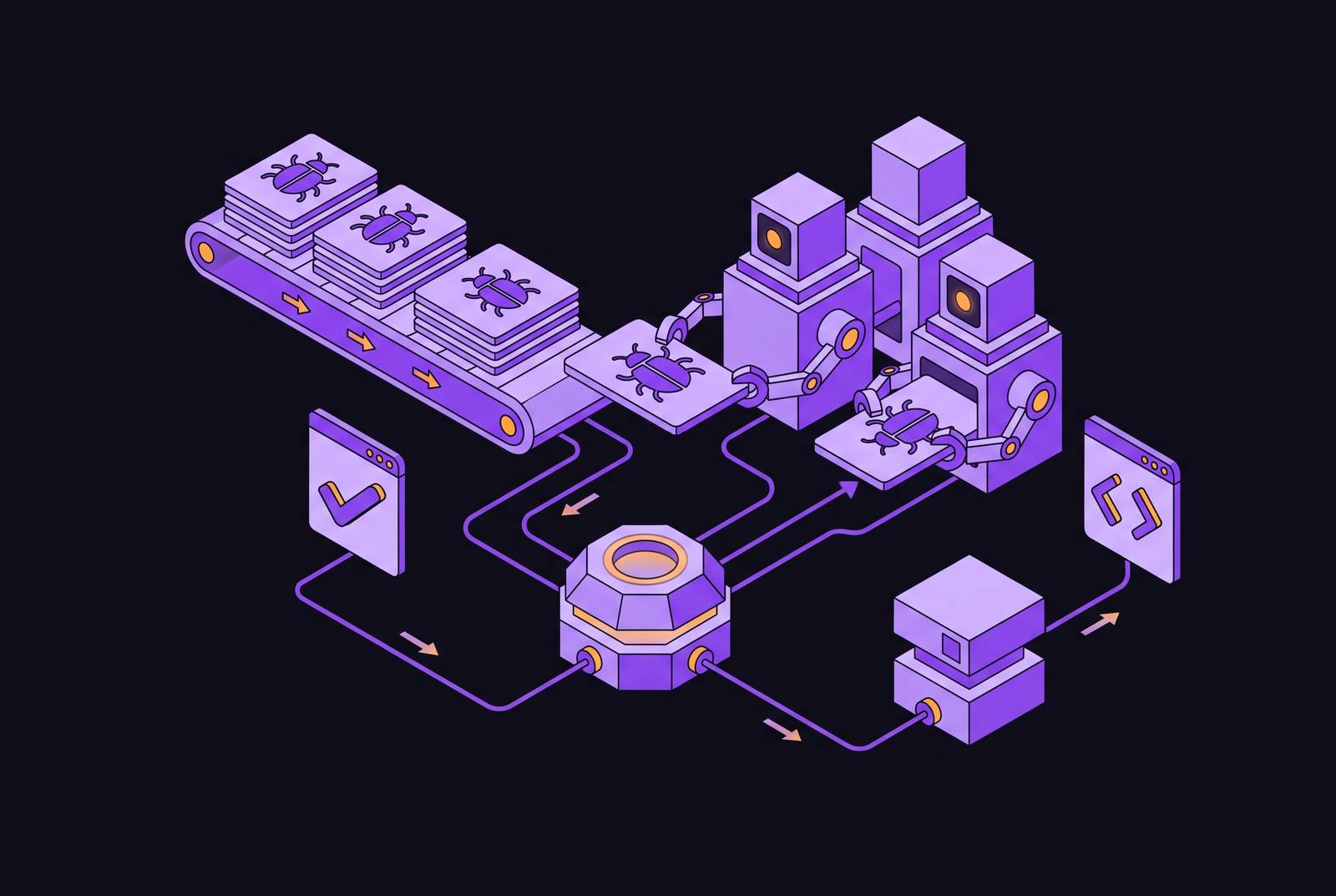
Delegating Linear bug tickets to coding agents is a workflow. Reliable delegation depends on a precise ticket, complete context, a suitable execution environment, accurate status updates, and a reviewable pull request. Getting those handoffs right separates work that ships from work that stalls or creates more work for the engineer.
Why bug tickets are now the unit of delegation, not just communication
A Linear ticket becomes an executable specification when an agent takes the assignment. With traditional tickets, a human teammate could ask questions, fill in missing context, and agree on scope. Agents instead act on what is written, then stop or guess when instructions run out. That changes the ticket’s job. A description sufficient for sprint planning can be insufficient for execution because the assumptions once supplied through conversation now need to be explicit.
The tracker is also becoming a participant in the work. In some Linear workspaces, agents now create up to a quarter of all new issues autonomously. The flow runs in both directions. Engineers therefore need tickets that support both delegation into the codebase and a clear account of what comes back.
What makes a bug ticket an agent can actually act on
“Search feels broken” gives an agent a topic to explore. Compare it with “issue search excludes archived projects even when the toggle is on, fix by reusing the existing includeArchivedProjects flag in issueSearch.ts”. The second version supplies behavior, a condition, and a relevant code surface. It bounds the search before execution begins. The distinction is useful even when the engineer does not know the likely fix.
For the next ticket, state the broken behavior, desired behavior, and relevant surface, including the expected UI or data model where applicable. Name known files, flags, and failing paths to constrain scope without removing the agent’s responsibility to reason about the approach. Include reproduction steps and the exact condition that exposes the defect. Without those, the agent may produce a change it cannot verify.
State exclusions just as explicitly as requirements. Files and services that must remain untouched cannot remain an unwritten team convention. Architecture changes, cross-service contracts, and vague feature direction are hard to delegate well because a fix that makes sense in one place may break assumptions in another. Workspace defaults provide another useful boundary. Linear’s workspace-level agent guidance, under Settings → Agents → Additional guidance, supplements every ticket automatically, so shared instructions need not be repeated in each assignment.
How to get the ticket's context into the agent without losing anything in translation
A well-written ticket still fails as a specification if the agent receives only a paraphrase. The handoff needs the full issue title, description, comments, and linked references. Context fidelity is a separate configuration problem. The workflow also needs a return path for status and a clear owner, with the human assignee remaining accountable for the output.
A Linear MCP connection lets the agent fetch issue details directly from an issue ID. Cursor’s bug triage guide demonstrates this pattern, including retrieval of comments. Configure the connection in the agent’s CLI so that the full issue is available during the work. Availability alone is not synchronization, however. The agent still needs to be told to fetch updates and post progress so it keeps up with changes after its first reading.
Without a live connection, a pasted handoff remains frozen at launch, and later comments do not reach the agent. GitHub workflow automation can handle PR-related status on its own, but the agent still needs access to the ticket’s context as it changes. Before writing code, the agent should also look through the git history that relates to the task. Earlier commits can reveal related work or show that the reported defect has already been patched.
The five ways to trigger an agent from a Linear ticket, and the tradeoff each one makes
The simplest route is opening the issue directly in a local agent tool. A person starts and supervises the session, which runs on their machine under their accounts. It is straightforward to begin but depends on their presence. Without another connection, context is frozen, updates do not flow back, and closing the laptop interrupts the work.
The second route adds a Linear MCP connection to the agent CLI. It composes with local opening rather than replacing it, providing live issue access and a way to post updates. The tradeoff is explicit orchestration. MCP does not determine where execution happens, preserve a session, or cause updates unless the agent is told to make them.
The third route uses a native agent integration that an admin installs and gives access to the team. Engineers delegate through assignment or an @mention while retaining human ownership of the issue. Linear’s integrations directory includes Cursor and Codex. Cursor filters out non-development work before launching a cloud agent. It resolves the repository from [repo=owner/repo], a “repo” label group, a project label, or the dashboard default, in that order.
The fourth route uses a webhook attached to a dedicated board column, such as “In Progress — Agent”. Moving an issue into that column starts a cloud agent that implements the ticket and returns a PR. Moving several tickets starts parallel work. Each run therefore needs its own isolated environment rather than sharing branches, ports, and state with the others.
The fifth route uses a label to prepare a workspace, followed by a person starting the agent on infrastructure the team controls. Nothing launches automatically, in exchange for maximum environment control. These routes are choices about supervision, context, and execution. Business and Enterprise triage rules can also auto-delegate incoming issues, but when a person no longer has to start the work, reviewing the resulting diffs becomes more of a constraint.
Where the agent actually runs, and why the environment is as consequential as the model
Agents need more than access to source files. They must install packages, run services, use a browser, and check that changes work without another process getting in the way. When tickets are delegated in parallel, each needs its own environment, ports, and branch. Isolation protects both correctness and team safety. Permissions should be scoped to the task, with no standing access to production secrets or unrelated credentials.
Network access is part of that boundary. Codex disables internet access by default during agent execution, while allowing it during the setup script for dependency installation. Its environments route outbound traffic through an HTTP/HTTPS proxy. That design limits exposure to prompt injection through external content. Environment policy therefore influences what the agent can encounter as well as what it can execute.
Stripe uses pre-warmed AWS EC2 devboxes, Ramp uses pre-warmed Modal Sandboxes, and Coinbase uses in-house infrastructure, with pre-warming a shared pattern. Cursor’s August 2026 Builds feature boots cloud agents into pre-configured environments and reports up to three times faster starts. These choices reduce repeated setup while keeping the model unchanged.
Continuity requires equal attention across workflow stages. A fresh session at every stage forces the agent to reread the codebase and reconstruct its earlier decisions. Persisting an issue-ID-to-session-ID mapping preserves that continuity from planning through PR creation. Working directories must remain consistent as well. Planning from one directory and creating the PR from a subdirectory can resolve a different session, producing failures that appear to be model errors but originate in infrastructure.
Choosing the agent harness for bug delegation — Claude Code, Codex, and Cursor
For this workflow, the useful comparison is integration and asynchronous behavior. Claude Code is at its best with long-context engineering and MCP-heavy work that spans many files. Its Linear MCP connection is well documented. Linear’s GitHub integration also supports coding sessions through Claude Code or Codex. The choice depends on whether the harder problem is maintaining codebase context, controlling execution, or making delegation accessible to the team.
Codex has native delegation from Linear, with the limits on cloud execution described above. It fits an asynchronous workflow in which engineers hand off a ticket and review a returned PR. Its network restrictions belong in the evaluation. A harness must let the agent set up the task and check its work using the permissions the environment grants.
Cursor combines native @mention delegation with inline pair programming and asynchronous cloud work. Its July 2026 Router feature gives admins team-level model defaults, while Model Access Control is limited to Enterprise plans. Builds handles how the environment starts, separately from which model is chosen. Tool selection deserves similar restraint across harnesses. Stripe’s internal Toolshed contains nearly 500 MCP tools, but its agents receive a curated selection, illustrating why available tool count is less useful than access to the right tools for the assignment.
Keeping Linear status accurate while the agent works
An issue that does not reflect active agent work prevents its owner from intervening at the right time. That displaces work onto the engineer. Cursor and Codex native integrations post progress and a final summary to issue activity, including links to the full chat and resulting PR.
Linear’s GitHub integration handles a different part of the feedback loop by updating issue status from PR activity. Link the issue through its ID in the branch name or PR title, or use “fixes” plus the issue ID in the PR description. Team-level workflow automations then govern status changes. For a custom harness, ambiguity also needs a return path. The agent should post questions to the issue or a linked Slack thread instead of guessing, keeping redirection in the same working context.
A dedicated “Agent In Progress” column makes delegated work visible without requiring teammates to inspect another tool. Automatic triage delegation also needs a way to flag spending. Pair it with a billing credit budget alert when enabled, because coding sessions consume credits and no plan includes a free credit pool. Accurate status gives engineers a chance to redirect work before it becomes a bad pull request.
Reviewing what the agent returns as a pull request
The returned PR is the handoff back to the engineer. The default should be a diff awaiting review before merge. Opening a PR provides that gate with better review ergonomics as confidence develops. Its scope must remain small enough to inspect. Cloud agents can produce diffs faster than most teams can responsibly review them, making review bandwidth the practical limit on delegation at scale.
Verification must be independent of the agent’s opinion of its work. Give the job a trusted test, lint, or type-check command and let failure block completion. Configure it in the job’s checks field, with at least one external check the agent did not write itself. Agents should not merge before those commands match what the reviewing engineer would have run. A QA plan written from the ticket before coding adds another safeguard because it tests how the feature should work for users, going beyond checks that the chosen code works.
Files outside the assignment signal that the next ticket needs tighter boundaries. A newly discovered repository should become a question about expanding scope, because each repository needs its own PR and review. Linear’s native Diffs feature supports review and merge within Linear, with semantically organized guided reviews. Comments, checks, and review activity synchronize bi-directionally with GitHub, but a convenient interface does not remove the human gate.
Measuring whether delegation is actually working
Who has a seat and how much they use a model do not show whether delegated tickets reach production through reviewed changes. Measurement should trace the path from assignment to merged PR. Weekly active agent users distinguish access from habit, while sessions per active engineer show whether use is experimental or embedded. Agent-assisted PR share connects adoption to shipping. Retention after four weeks shows whether people keep using agents after their first burst of curiosity.
The study of Microsoft’s rollout found that adopters merged roughly 24% more pull requests than the estimated baseline. Retention tracked baseline coding activity more than demographics, with the strongest advantage among the busiest engineers. First use spread primarily through social networks. That supports starting with a visible early-adopter cohort.
The backlog provides the final operational test. If bug and user-feedback queues are not shrinking while agent PRs accumulate, review has become the bottleneck. Each sprint’s metrics should feed changes to the next round of ticket specifications, environment configurations, and review gates. The teams that gain most will use delegation as an ongoing feedback loop.