Root Cause Analysis Agents in Production Engineering
Successful RCA agents depend on three sequential stages, not just final accuracy.
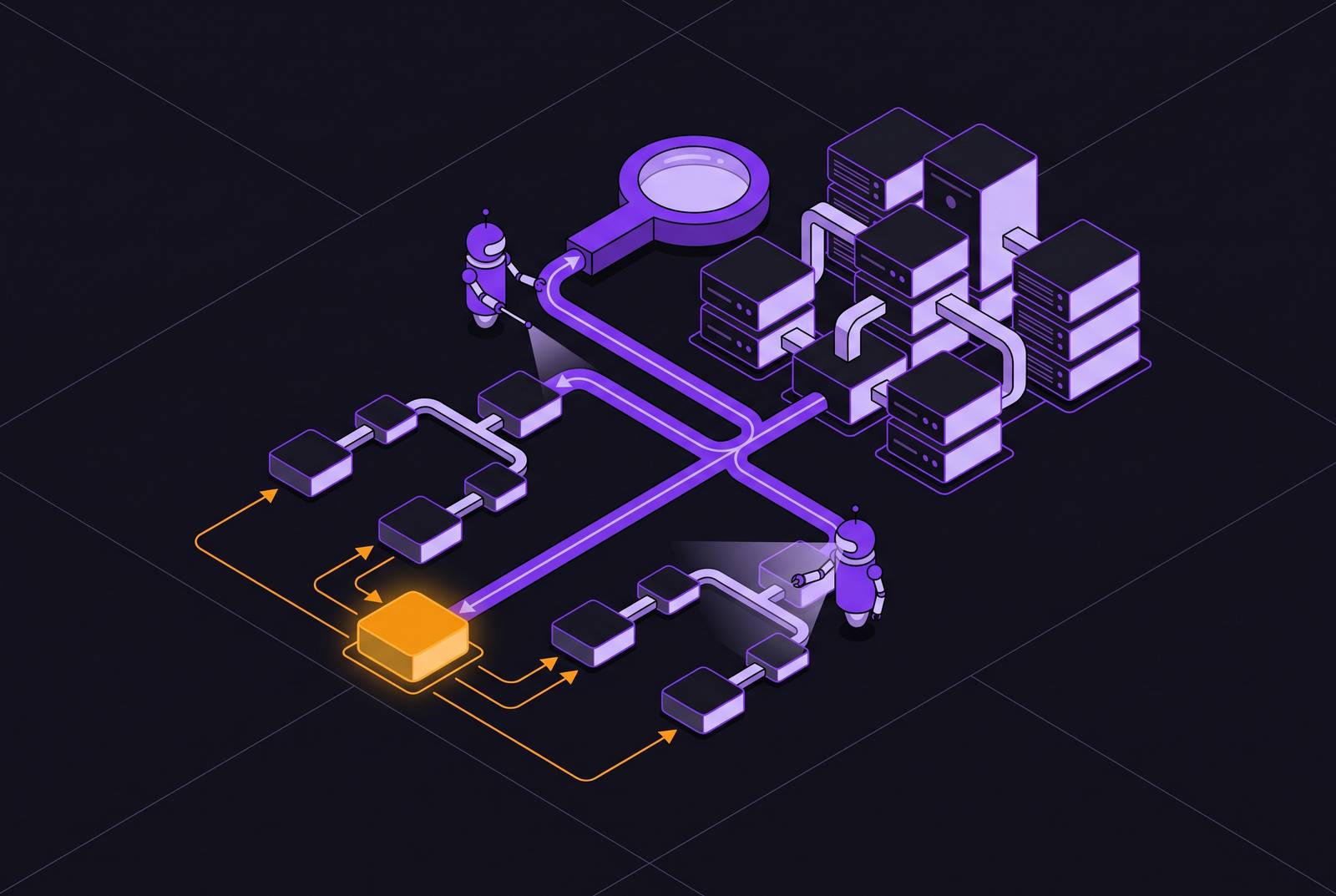
Root cause analysis agents in production engineering succeed or fail through three sequential stages, namely telemetry ingestion and normalization, cross-signal correlation, and evidence-grounded hypothesis generation. Reliable deployment depends on understanding the constraints and failure modes of each stage, rather than treating the agent as a single model that finds root causes. Even when a diagnosis sounds right, its evidence must hold up when checked.
Why the three-stage architecture is the right starting frame for RCA agents
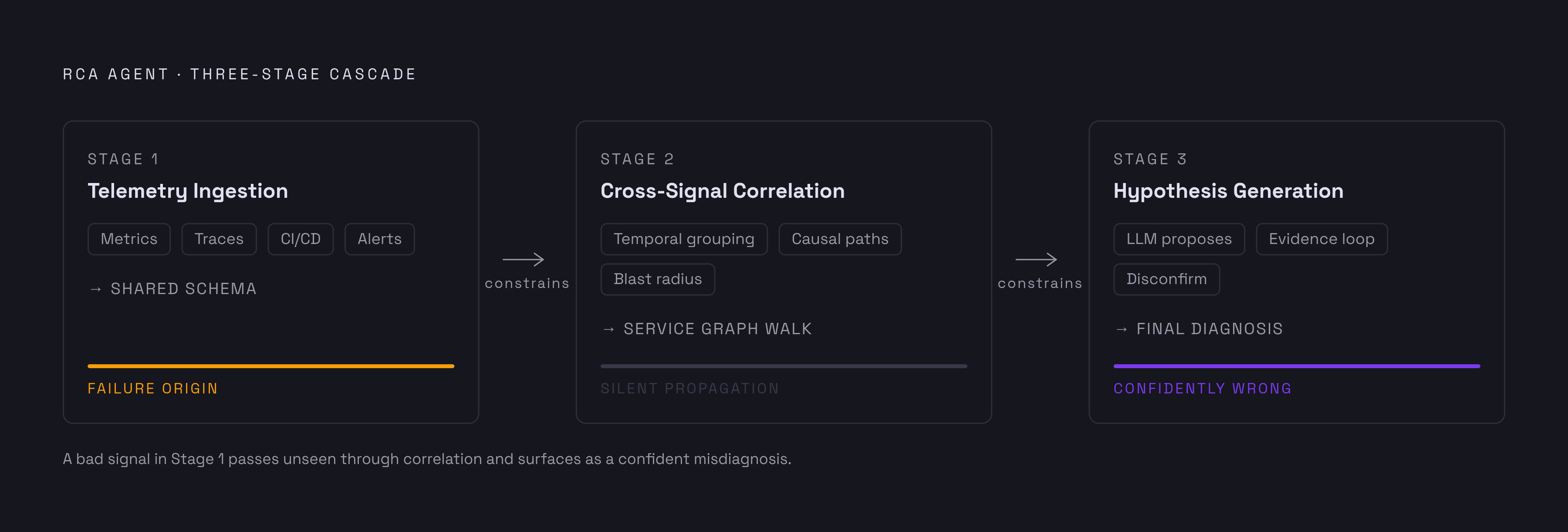
An RCA agent’s output quality is determined sequentially. Ingestion establishes what evidence is available, correlation establishes which signals belong to the incident, and hypothesis testing determines what those signals support. Each stage constrains what the next can establish. Struct explains that poor ingestion leads to poor hypotheses no matter how strong the model is, and that skipping a stage leads to answers that sound confident but are wrong. A failure at the first stage may therefore remain hidden until the agent reports a root cause at the third.
This dependency makes a stage-by-stage account of system components necessary for explaining deployment outcomes. Final-answer accuracy cannot show where an investigation went wrong. Lu et al.’s trajectory study on RCABench illustrates the distinction by showing that correct localization can hide deficiencies in causal reconstruction. An agent can identify the fault source without reconstructing its propagation path or grounding its diagnosis in evidence. The three-stage frame exposes that gap by asking how the agent reached the answer.
What happens in stage one: ingesting and normalizing telemetry across signal types
RCA agents commonly receive metrics through OpenTelemetry and Prometheus, distributed traces through Jaeger, deployment history from CI/CD pipelines and deployment records, and alert streams from PagerDuty and Alertmanager. These inputs show different parts of what happens in production. Normalization converts them into a shared resource schema so the agent can join them on trace and resource identifiers. Without those joins, cross-service correlation is structurally impossible, however much telemetry the agent receives.
Struct specifies three propagation requirements for joinable telemetry. Trace context must propagate across every service hop. Every log record emitted inside a span must include trace_id and span_id, while metric measurements taken inside a span must include the trace_id as an exemplar. These requirements connect observations that would otherwise remain separate. They establish the relationships the next stage needs to follow an incident across services.
Manufacturing exposes the same problem through physical context. A metric named “speed” or “temperature” does not necessarily identify its place in the process or the mechanism it reflects. Oden Technologies addresses that ambiguity by gathering line diagrams, parameter mappings and descriptions, process knowledge, and operator interviews before analysis begins. Source code is just as essential when investigating software. Struct reports that removing code access reduces accuracy and increases hallucination rate for every model evaluated on a benchmark, because symptom grouping alone cannot establish whether production behaves as intended. Yet missing context need not stop the agent. It can proceed through correlation and hypothesis generation without an ingestion error, leaving the failure visible only in a confidently wrong diagnosis.
What happens in stage two: correlating alerts and mapping blast radius across the service graph
Correlation groups individual anomalies into an incident whose boundaries follow the service dependency graph. Struct describes temporal grouping within an incident window and topological grouping along a shared causal path. Time alone does not establish that path. Topological correlation distinguishes affected services from unrelated ones, producing the blast radius that guides investigation. The search then starts from the earliest abnormal signal and works forward through the graph, rather than treating every alert as an equally plausible origin.
A broken join at ingestion leaves a connection missing, while a failure in correlation sends the investigation down the wrong branch. Lu et al. found that agents drifted toward unrelated services or kept making shallow queries, failing to follow fault propagation. The study analyzed 5,000 agent runs across ten framework–backbone configurations on RCABench and identified omitted evidence, misinterpreted evidence, and unsupported reasoning as features of failed investigations. Model capability alone did not explain those failures. In successful investigations, agents used the evidence they had found to guide their next queries and explored a wider range of diagnostic intents. Correlation is therefore a live search.
Oden describes a chain in which a speed change creates a buffer imbalance, a temperature moves out of range, tension drifts across the web, and a downstream station becomes unstable. Its framework maps process context to find which upstream signals could be involved, then uses trained models to narrow the search before hypothesis generation. Struct notes that the unstable station, a downstream symptom, is not necessarily the source and that feature-attribution methods such as SHAP can assign contribution scores useful for generating hypotheses, but cannot establish causation. Stage two must preserve that distinction for the evidence-testing loop that follows.
What happens in stage three: generating and testing hypotheses against evidence
Hypothesis generation is an iterative query loop. The LLM proposes an explanation, examines supporting and conflicting evidence, and uses unresolved questions to guide further investigation. Premature closure ends that loop before there is enough evidence to reach a conclusion. Scale AI’s Continual Search paper documents one-shot LLM judges settling early on plausible diagnoses and leaving critical evidence in longer execution traces unexamined across four RCA benchmarks. Continual Search challenges the standing answer at successive turns and searches for unresolved evidence, improving attribution across benchmark suites and model families, with substantial gains on MegaRCA-Mix.
Reaching the right service does not complete the investigation. Lu et al. document agents arriving at the root cause service, leaving its metrics uninspected, then rechecking the symptom and reporting the affected service as the answer. That failure is visible in the trajectory. A final localization score cannot explain how the agent bypassed the evidence needed to distinguish cause from effect. More searching is not automatically the remedy if the agent misjudges what it has already found.
Zhejiang University’s EviRCA separates evidence extraction from reasoning to address the instability of asking one model to retrieve telemetry, localize faults, and infer causes simultaneously. A system-agnostic extraction stage converts raw metrics, traces, and logs into compact, faithful multimodal evidence cards. EviRCA reports a Correct rate of 40.6–43.9% on OpenRCA while reducing token consumption and execution time by large margins. Its process-level analysis identifies judging surfaced evidence, rather than finding new evidence, as the binding difficulty. Clean inputs still require disciplined interpretation.
That discipline must extend beyond statistical association. Struct explains that correlations alone cannot answer why a failure happens, and that historical associations can become invalid when a human changes a system parameter. Reliable hypothesis testing combines statistical analysis, temporal relationships, and engineering constraints with the LLM’s proposed explanations. Missing identifiers from stage one or a mistaken causal branch from stage two undermine that work, regardless of the loop’s sophistication. The key step is to rule out hypotheses with disconfirming data, going beyond ranking them by correlation strength.
What a credible RCA output looks like and why most agents don't produce one
A credible report makes the investigation inspectable rather than concealing shortcuts behind a plausible narrative. Struct specifies an output that identifies the alert that fired, the alerts grouped into one incident, and the blast radius across service dependencies. It also requires a cited timeline linking every claim to a specific log line, trace span, or diff. The report must name eliminated hypotheses and the disconfirming data for each, state a root cause with a confidence score, and recommend a fix. It must explicitly state what remains unverified. That last element distinguishes a bounded conclusion from a guess presented as settled fact.
These elements expose different failures in the three-stage process. The grouped alerts and blast radius reveal the incident boundary, while the cited timeline exposes the evidence behind the proposed causal chain. Eliminated hypotheses show whether the agent tested more than the evidence for its favored answer. A confidence score cannot replace that record. Nor can a correct service name establish that the agent has explained how the fault propagated.
Lu et al. show that standard metrics, including top-k accuracy (Acc@k), mean reciprocal rank, and mean average precision, score fault-source localization and leave grounded reasoning unmeasured. An agent can therefore score well without constructing a verifiable causal chain. Struct reports that, across multiple studies, accuracy in production is much lower than benchmark scores. The corrective is process-level evaluation, which the trajectory study performs using fault-propagation paths as causal ground truth and examining evidence navigation, diagnostic intent breadth, and recurring failures at individual steps.
The infrastructure conditions that make all three stages reliable rather than fragile
Correct execution on one incident does not establish repeatable production behavior. A shared execution environment can contaminate the evidence an agent is investigating, while an environment unable to reproduce incident conditions limits what it can test. Isolation is therefore part of diagnostic reliability. Agents that run remediation scripts or follow-up queries against production-adjacent environments need their own execution contexts as well as access to a capable model. The environment must preserve the conditions under which evidence is gathered and interpreted.
Long investigations make that requirement more demanding. An RCA spanning a dozen microservices over hours accumulates context across many tool calls, and compaction in a shared or memory-constrained environment can summarize away the connections between observations. Those connections are needed to avoid premature closure. Persistent project memory, such as CLAUDE.md in Claude Code, autonomous retry cycles, and subagent delegation can support longer investigations. Their safe use still depends on isolation in the execution environment.
Organization policies must scope identity and permissions to the telemetry sources an agent may query, while data controls determine which logs, traces, and deployment history can leave the team’s environment. Sandboxed, network-allowlisted execution constrains agent-triggered queries so they cannot affect production state. Human review remains a separate safeguard. Rules on merge and remediation keep a person involved before a proposed fix is applied.
Attribution makes those controls auditable and improvable. Every run needs a record of which agent, model, credential, and source triggered the investigation, with usage attributable to the source, harness, model, and credential. Without that record, teams cannot connect a misattribution to the infrastructure condition that produced it. Audit and cost belong to the same run-level account. Together, these conditions let teams examine not only the diagnosis but also the circumstances under which the agent reached it.
How RCA agents fit into the workflows engineering teams already use
An evidence-grounded report has limited team-wide value if engineers must leave their incident workflow to retrieve it. The documented integration pattern starts where the incident is tracked, including Slack, Linear, GitHub, or a monitoring alert. The agent investigates independently and returns a pull request, reply, or report through that same channel. No separate interface is required for the handoff. Struct describes an asynchronous workflow in which the agent reads PRs to create monitors calibrated to code changes, baselines after deployment, triages alerts, and delivers cited root causes.
Sentry runs RCA on linked error issues inside Linear, placing the investigation result and the issue in a single thread. Accountability stays with the human assignee, while the agent acts as a contributor. Slack delegation follows the same entry-and-return pattern. Engineers assign an incident from chat, and the agent returns findings there without requiring a dashboard visit.
Harness choice also affects how well that workflow can adapt. A team tied to one RCA agent accepts the limits of its current capabilities, while routing investigations by telemetry type or context-window needs allows the workflow to benefit as models improve. The relevant outcome is not investigation volume. Engineering leaders should track the fraction of investigations that return a cited, confidence-scored report a human can act on within the same shift. That measure distinguishes background agents delivering actionable work from interactive copilots offering suggestions.